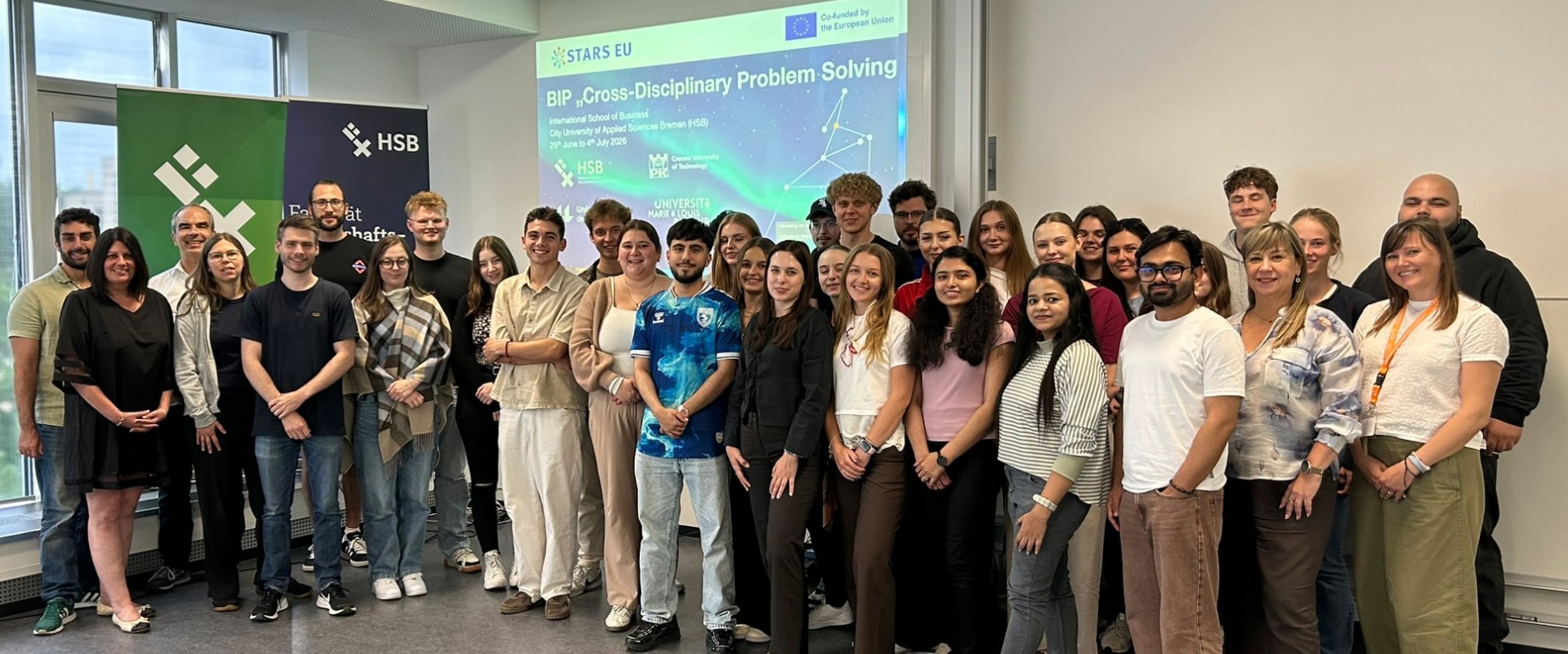
From 29 June to 4 July 2026, Hochschule Bremen hosted its first Blended Intensive Programme (BIP) on "Cross-Disciplinary Problem Solving" within the framework of the STARS EU Alliance comprising nine European universities. The programme combines digital online sessions with an in-person week and brought together students and academics from Germany, France, Poland and Spain to jointly analyse and explore future-relevant challenges.
The STARS EU BIP brought together over 30 students and academics from four countries and different disciplines: from the Dual Study Programme in Public Administration B.A. and European Studies M.A. at Hochschule Bremen (HSB), from Natural Sciences and Economics at the Universidad de La Laguna (ULL) in Spain, from Law at the Université Marie & Louis Pasteur (UMLP) in France, and from Engineering Sciences and Architecture at Cracow University of Technology (CUT) in Poland. This interdisciplinary composition enabled participants to analyse future-relevant challenges from multiple perspectives.
As Prof. Dr. Martin Holi, the academic organising the BIP, emphasises: “Future-relevant challenges such as artificial intelligence or wealth inequality cannot be understood from a single disciplinary perspective. The BIP makes this the very core of its approach: engineers, natural scientists and public administration experts in direct dialogue.”
The week began with intensive team-building activities, including creative workshops, Lego® Serious Play®, Human Bingo and Liberating Structures – proven methods to quickly transform strangers into a functioning team. Additionally, workshops such as the Innolocal Workshop (Prof. Dr. Lydia Scholz, Verena Beckhusen and Prof. Dr. Christiane Trüe) were offered – a practical example of how innovation in the public sector can be fostered. Furthermore, Dr. Regine Komoss provided input on Strategic Foresight, equipping students with tools for future analysis.
Students subsequently worked on a broad range of future-relevant topics: Future of Work, Artificial Intelligence, European Defence Policy, Wealth Inequality and even football – a spectrum that demonstrates how future challenges are omnipresent.
The intensive week was not an isolated experience: BIP participants attended the opening exhibition of the STARS EU Living Lab "Outer Campus" (Prof. Dr. Maria Petra Clark and Janina Ebner) at Hochschule Bremen and participated in university-wide events such as "When Business meets Computer Science: Designing the Future with AI" (facilitated by Dr. Regine Komoss and Prof. Dr.-Ing. Dennis Kampen). They also attended the final presentations of the Sustainable Business & Entrepreneurship M.A. programme and gained insights into challenge-based projects with regional food start-ups.
Final Presentations: European Expert Review
In the final presentation session, students showcased their poster presentations and analyses covering their respective subject areas. These underwent constructive critical evaluation: five professors from the STARS EU universities examined the results for conceptual robustness and empirical grounding – offering invaluable feedback at the European level.
Social Activities: Exploring Hochschule Bremen and the City
Beyond the academic intensity, personal interaction was central to the programme. Activities included a joint social dinner, attendance at the Breminale open-air festival and shared sports activities – opportunities for European students to get to know Bremen and each other better.
Making It Happen: European Collaboration
The BIP was organised by Prof. Dr. Martin Holi and implemented in close collaboration with academics Prof. Dr. Célia Berger-Tarare (UMLP), Hugo Padrón Ávila (ULL), Prof. Dr.-Ing. Elżbieta Malec (CUT) and Prof. Dr. Patrycja Haupt (CUT).
We extend our heartfelt thanks to Simone Schwarz, Corinne Trümpler and Ann Mary Bosco from the International Office of the Faculty of Economics for their outstanding support throughout the week – without their dedication, such a seamless implementation of the BIP would not have been possible.
The BIP "Cross-Disciplinary Problem Solving" demonstrates what European collaboration in higher education can achieve: students and academics from different disciplinary cultures and countries come together, engage in serious and critical discussion of future challenges, and build European networks that extend well beyond the programme week. That this took place for the first time within the STARS EU Alliance at Hochschule Bremen represents an important step in strengthening the university's international profile and preparing our students for an increasingly complex, interconnected world.
The BIP is funded under the Erasmus+ programme.