Our profile
At Hochschule Bremen - City University of applied sciences (HSB) internationality enjoys a high priority at all levels: from international degree programmes, through exchange and cooperation in research, to strategic projects.
Hochschule Bremen - City University of Applied Sciences (HSB) is a member of the STARS EU university alliance. The abbreviation stands for Strategic Alliance for Regional Transition European University - the network was initially called ENGAGED. Since November 2023, STARS EU has been funded by the EU with 12.4 million euros, initially until October 2027. In addition to HSB, universities in the Netherlands, Sweden, France, Spain, Portugal, the Czech Republic, Poland and Albania are involved.
The special thing about it: HSB is one of only 18 universities of applied sciences (HAW) in Germany to receive funding from the EU to create a European university with its partner universities. This is an honour and a great opportunity to further promote the internationalisation of HSB in Europe.
The alliance combines the strengths of nine traditional, complementary European universities. The overarching goal is to build an alliance of committed universities in order to establish a future-orientated European university. It aims to create a new generation of students and innovative, flexible and diverse education and challenge-based research systems.
At the regular STARS EU conferences and working meetings, ideas can be developed and taken forward - for example on the topics of energy transition, the circular economy, start-ups and innovation or health and how the nine universities can learn from each other. Bremen and the region benefit from STARS EU.
Since 2005, we have maintained contacts with universities in North and South America through UAS7, an association of seven research-intensive universities of applied sciences, and its office in New York as well as a representative office in Brazil.
As a member of the European University Association, HSB participates in educational and research policy exchange at the European level.
In a globalised world, international and intercultural skills are essential success factors for a professional career. HSB recognised the importance of this early on and was one of the first universities nationwide to create international degree programmes with integrated stays abroad. Spending time abroad is now an integral part of the curriculum in more than half of our degree programmes. Around 60 percent of HSB graduates gain experience abroad during their studies.
We also create a reliable framework for all students that makes it possible to gain international experience during their studies. A cornerstone of internationality at HSB are the about 360 cooperation agreements with universities and diverse companies and organisations worldwide. In some cases, international cooperation dates back to the early days of HSB, such as with the Technical University of Gdansk in Bremen's twin city, and we are constantly developing our network.
In line with their professional and personal interests, the world is open to HSB students in a variety of ways during their studies.
HSB has been involved in Erasmus+ and PROMOS for a long time. Thanks to the promotion of international mobility through these partial scholarship programmes, the number of students at HSB who spend a semester abroad has risen continuously.
The Erasmus programme, initiated by the EU Commission, promotes not only student mobility but also lecturer and staff mobility with partners in the Erasmus area. In addition, cooperation projects with partners within and outside Europe are funded.
HSB was awarded the Erasmus Charter for the entire duration of the Erasmus programme on the basis of its Erasmus+ Policy Statement. The award of the Erasmus Charter, which is valid until 2027, entitles HSB to apply for and implement Erasmus measures.
Proportion of international study programmes
University cooperation in about 70 countries
of graduates gain experience abroad during their studies – A cosmopolitan campus (rounded figures)
University life on campus is also international and multicultural: Around 240 incoming students from about 70 countries come to HSB during the academic year to study here for a semester, and roughly 250 more international students take part in our international summer schools. HSB students also have diverse cultural roots. This is an asset for us. International guest lecturers enrich campus life.
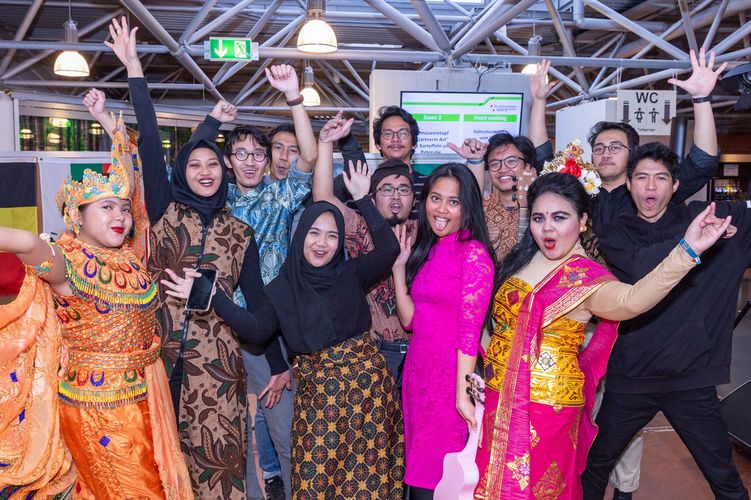
At the International Graduate Center IGC, the importance of exchange across national borders can already be seen in the name. Students from about 40 countries study in the predominantly English-language Master's and MBA programmes at the IGC. The International Day is all about openness to the world: returnees talk about their experiences abroad and international students present their home cultures. The programme of information, culture and culinary delights is an annual highlight in the HSB's catalogue of events.
The international orientation is also noticeable in the structure of the HSB. Responsibility for internationality lies at the highest level, namely with the Rector. In addition to the central International Office, each faculty has a decentralised International Office, which advises HSB students going abroad and looks after students from partner universities coming to Bremen. Last but not least, a number of HSB research institutes deal with international issues from various scientific perspectives. We actively promote international research collaborations.