HSB
Hochschule Bremen (HSB) – City University of Applied Sciences applies science to practical situations and plays an important role in society and economy. It offers future-proof and innovative study programmes as well as basic and practice-oriented research. Through its close cooperation with over 200 partners from science, business, society and administration, it ensures that Bremen and the surrounding region have the skilled workers they need.
With its international orientation, HSB has an extensive network of around 360 partner universities worldwide. It is one of only a few universities of applied sciences (HAW) in Germany that are part of an EU-funded European university: the STARS EU university alliance (Strategic Alliance for Regional Transition European University) .
HSB offers a wide range of more than 70 degree programmes in engineering, natural sciences, economics, social sciences and health sciences. It has almost 9,000 students. The International Graduate Centre (IGC) is an excellent further education institution for young professionals from all over the world and working people from the region.
HSB's profile is geared towards current issues facing society and the economy, which are cross-cutting themes throughout its study programmes and teaching. These include:
Almost 9,000 students can choose from more than 70 predominantly international bachelor's and master's degree programmes across five faculties. The individual degree programs at HSB are interdisciplinary in nature. They focus on technical and practical collaboration within and between faculties throughout the course of study.
The spectrum of subjects covered can be classified as natural sciences and engineering, economics, and social sciences. Interdisciplinary teaching and research fields related to global challenges such as sustainability, artificial intelligence, health, ecology, urban development, globalization, new forms of work, and mobility are continuously integrated into the study programmes and accordingly further developed.
faculties
bachelor's and master's degree programmes
students
For more than 50 years, HSB has been making a tailored and needs-based contribution to securing the availability of highly trained specialists and promoting innovation in Bremen's economy, administration, and civil society. With its nationwide acclaimed profile (practical orientation + internationality + lifelong learning) that is unique in the state of Bremen and the Northwest of Germany, it thus makes a substantial contribution to the political goals of regional development.
Being a university of applied sciences, HSB has always focused on close cooperation with trade and industries. Even during their studies, students can participate in practical semester projects, often in direct collaboration with HSB's partners. Around 90 percent of students write their theses with a practical and business-related focus. HSB is continuously expanding its dual study programmes.
cooperative degree programmes (or comparable)
cooperations with companies and organisations in cooperative programmes
of final theses 90% of theses relate to practical and business contexts
The vast majority of degree programmes have integrated stays abroad with practical or study semesters or they are conducted (entirely or partially) in English or offer opportunities to participate in cooperative international Blended Intensive Programmes (BIP) and further international exchange formats.
The international experience gained by graduates greatly benefits their career opportunities, as international experience and intercultural skills are increasingly in demand in a globally networked economy, science, and society. Last but not least, engaging with other cultures also promotes the personal development of our students.
© HSB - Marcus Meyer
countries with partner universities
of degree courses with international focus
partnerships with universities worldwide
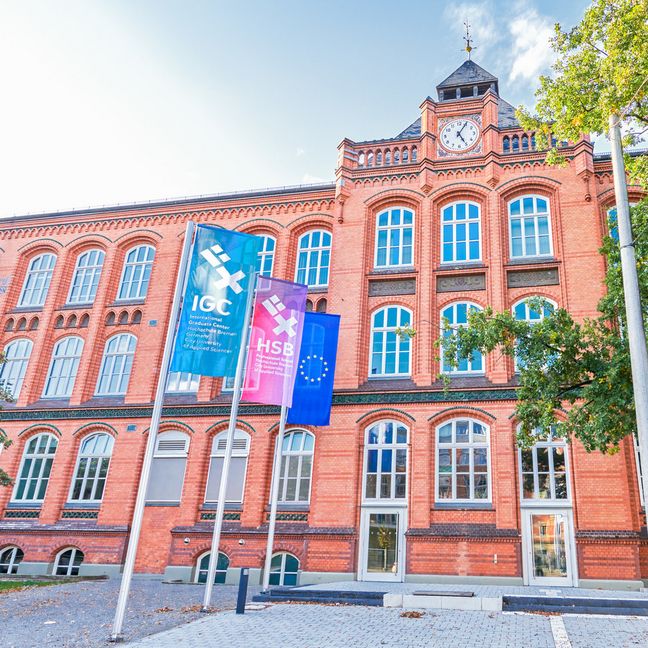
Der Eingang zum International Graduate Center der HSB an der Langemarckstraße.
© HSB - Marcus Meyer
In a society where knowledge is the most important basis for value creation, continuing education plays a central role in terms of lifelong learning.
For over 20 years, the International Graduate Center (IGC) at HSB – City University of Applied Sciences has been successfully operating as a graduate and business school. Young professionals from all over the world, with university degree and professional experience, find excellent opportunities in the field of academic continuing education at the master's and MBA level at the IGC.
The Centre for Teaching and Learning (ZLL) bundles a wide range of offerings for different target groups at Hochschule Bremen in the context of studying and teaching. It offers relevant continuing education and training opportunities to students (StudiumPlus), teachers (LehrePlus) and HSB employees alongside their studies and teaching.
In general, German universities of applied sciences (HAW) also also enable certain groups of people to study even if they do not possess a general or subject-specific higher education entrance qualification. This principle of an “open university” is a central concern of HSB. For years, HSB has been designing its lifelong learning offerings in close cooperation with companies and their human resources development Needs.
HSB also generates impetus for regional development through its activities in the field of basic and applied research. This is reflected in its wide range of research activities and in the interdisciplinary composition of the research teams, most of which including external cooperation partners from industry and science.
HSB's Research and Transfer Department accompanies projects from the initial proposal phase through implementation up to the transfer of results to science, industry and society. To promote young scientists, the HSB currently supports around 60 cooperative doctoral projects, to a large extent in cooperation with the University of Bremen and the Carl von Ossietzky University of Oldenburg.
In terms of content, six research and transfer clusters have emerged that are linked to the high-profile research priorities of the state of Bremen:
With the digital transformation in teaching and learning, administration, and research, HSB is pursuing a cross-cutting strategy that is central to competitiveness. Among other things, this strategy relates to the objectives of the state concept of Bremen and thus, it is being implemented in coordination and partly in cooperation with other universities in the state.
Digitalisation is changing the world of work and society in many ways. HSB’s degree programmes are designed to teach the skills needed to meet the associated requirements. The faculties review and update their course offerings and continue to develop them. Different digital teaching and learning formats, as e-Learnings or Blended Learning, ensure and support students’ learning progress. The current state programmes for the digitisation of teaching and services are creating momentum for the dedicated work being done in the degree programmes and service areas.
In addition, we are using successfully acquired funds to test innovative models in digital teaching and expand the necessary infrastructure. Additional professorships on this future-oriented topic are continuously being established in the faculties. This will create additional potential for competence development in teaching and learning. HSB research and transfer with companies will also be intensified as a result. E-government, the digitisation of administrative processes, and "Bologna Digital" are key requirements in university development for the coming years.