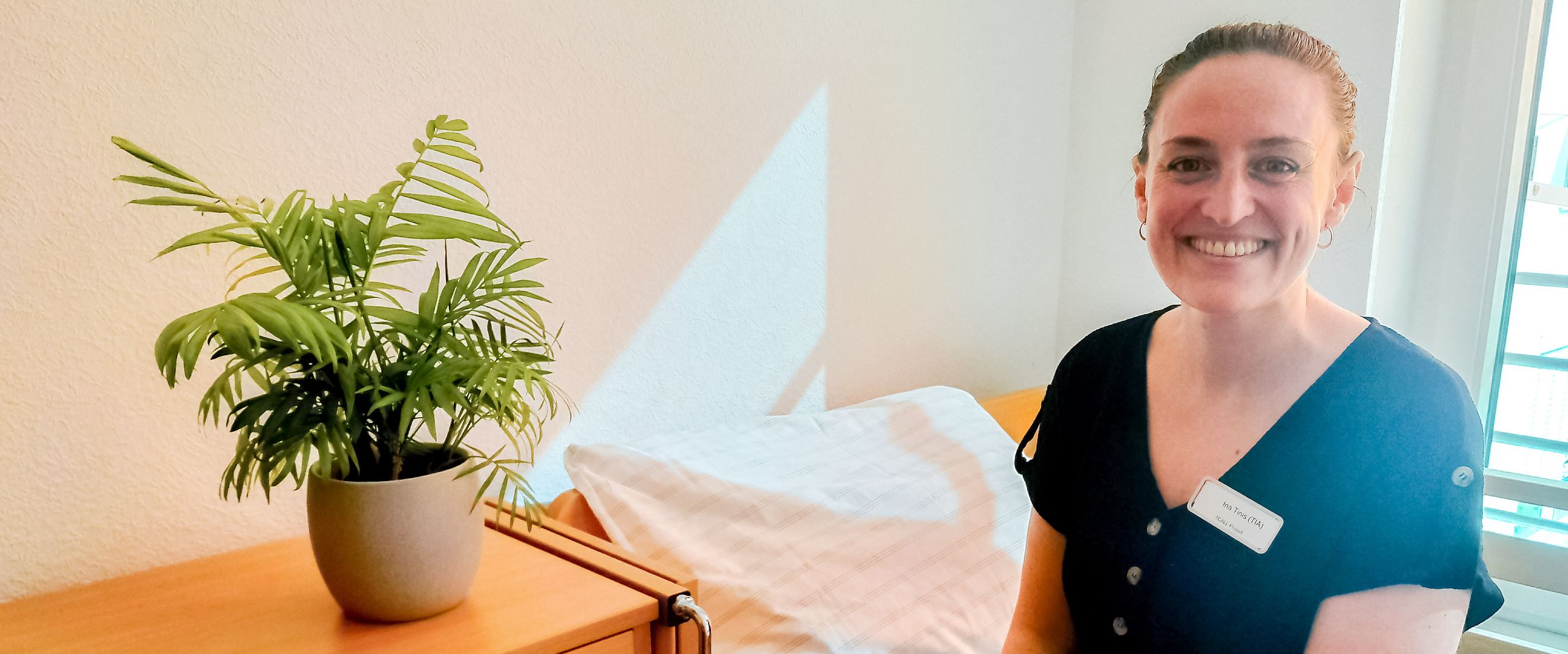
Hochschule Bremen (HSB) thrives on the people who study and work here, and who enrich the university as visitors. In our ‘Three Questions for…’ section, we introduce some of these people – along with their perspectives, projects and visions. HSB project staff member Ina Tinis spends a large part of her working hours at the St. Franziskus nursing home in Bremen-Schwachhausen. In this interview, she explains what this has to do with academia.
Ms Tinis, we are here for the interview in a room at the St. Franziskus nursing home in the Caritas Centre in Bremen. There is a desk, a large monitor and an empty nursing bed here. What is the story behind this?
Ina Tinis: We have set up this room as part of the TCALL initiative. The acronym stands for ‘Transfer Cluster of Academic Teaching Care Institutions in Long-Term Care’. It is a nine-year project run by the University of Bremen and Bremen University of Applied Sciences in collaboration with the Centre for Nursing Research and Consultancy (ZePB). TCALL is based in Bremen and aims to establish close cooperation with long-term care institutions. Together, they intend to identify development needs, select innovations, and introduce and evaluate them.
The room we are in is a quiet space for all staff at the care home – a sort of learning haven. Here, staff can reflect on and expand their knowledge. They have a dedicated space where they can work undisturbed or acquire the latest specialist knowledge. We will soon be receiving simulation manikins. This will allow us to conduct short training sessions right at the patient’s bedside.
This kind of approach is new in elderly care. Generally speaking, there are only academic teaching hospitals where external training takes place. So we are establishing a new learning culture amongst staff right at their workplace.
What does your work actually involve?
Ina Tinis: In Bremen, we have three pilot facilities: here at Caritas-Haus St. Franziskus, at Johanniterhaus Bremen and at Haus St. Elisabeth. A TCALL project staff member from the HSB works at each of these locations. We call ourselves TIAS – Transformation and Innovation Agents. On site, we take part in the team meetings at the respective care facility and speak with colleagues. This allows us to get a feel for day-to-day life and identify problems. Together with other research staff from the HSB and the University of Bremen, we develop and evaluate potential solutions. In doing so, we act as a bridge between research and practice. And if the solutions prove successful in practice, they are to be rolled out to other care facilities – eventually nationwide.
Can you give some examples of problem-solving in your care home?
One example is challenging behaviour in people with dementia. The topic came up during a team meeting. As part of TCALL, we hold case discussions and are developing a short training series on this topic. Both of these already exist, of course, but thanks to TCALL they are now more intensive. We also offer short learning modules: short podcasts or videos, for example, which we can produce at the HSB’s Skills and Simulation Centre on the City Campus at Brill. We are very well equipped there.
Another example is a voice-controlled app that we are currently introducing into staff members’ daily work routines. It is designed to help them manage everyday tasks more easily, such as regular documentation whilst working with residents.
About TCALL
TCALL (Transfer Cluster of Academic Nursing Education Institutions in Long-Term Care) is being carried out as part of the T!RAUM initiative of the Federal Ministry of Research, Technology and Space (BMFTR). Project partners include Hochschule Bremen, the Centre for Nursing Research and Consultancy, the Institute for Public Health and Nursing Research at the University of Bremen, and the Centre for Media, Communication and Information Research (ZeMKI, also at the University of Bremen). The project is led by the University of Bremen.
TCALL comprises various sub-projects addressing different aspects of digitalisation, learning infrastructure and staff development in long-term care. These include, for example, the development of digital learning environments and the training of transformation and innovation agents (TIAs).
The project is scheduled to run for nine years and is funded with a total of 16 million euros.