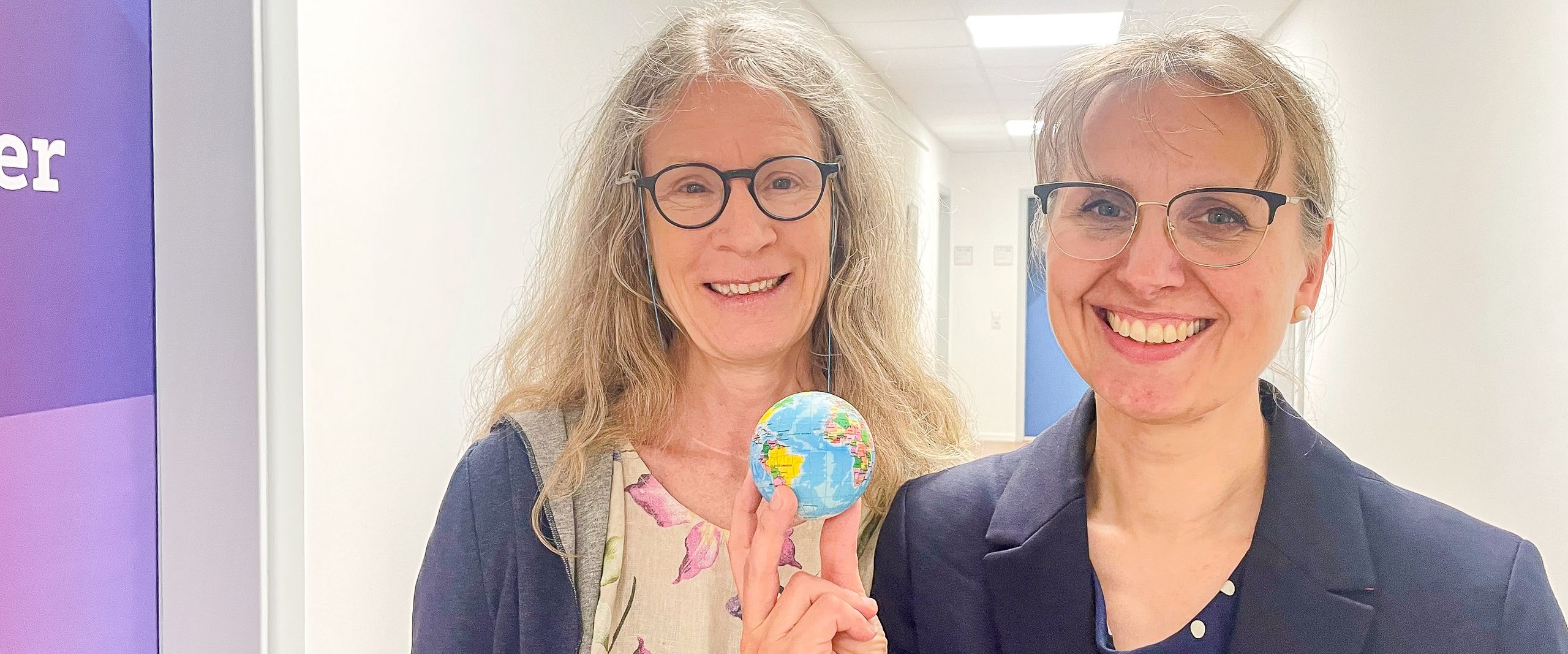
Hochschule Bremen - City University of Applied Sciences (HSB) has an international focus. A semester abroad is a standard part of most of its more than 70 degree programmes. The STARS EU university alliance promotes internationalisation at further levels: students take part in international learning formats. At the university policy level, they can represent their fellow students’ interests on the Student Board. Lecturers also benefit from STARS EU in teaching and research. Examples include Dr Sabine Lins, Professor of Nursing Science at HSB, and Dr Babette Müller-Rockstroh, Professor of Midwifery Science at HSB. Both are involved in the STARS EU TIG “Healthy Ageing”. The abbreviation stands for “Thematic Interest Group”. These are structured, subject-specific working groups within the European university alliance that bring together research, teaching and regional partners on specific key topics.
Sabine Lins: In terms of teaching, it serves as an important networking hub for us. Through the regular online meetings and the annual in-person gatherings, we can exchange ideas and identify potential partners. In addition, the online meetings often provide us with expert input on tools and methods. For example, members from the various STARS-EU partner universities present their research projects or teaching modules. One particularly impressive contribution came from a colleague in Groningen, who presented his research findings on the benefits of and how to initiate interprofessional collaboration.
Babette Müller-Rockstroh: Potential BIPs for students are also announced: Blended Intensive Programmes. This has frequently opened up opportunities for our students to participate in BIPs. It provides an insight into how teaching is planned and delivered in other countries. It is very exciting to see how flexible other universities are in this regard – very inspiring! Through the TIG ‘Healthy Ageing’, we have also been able to attract guest lecturers for our teaching. The teaching exchange, if you will, has thus also been funded by STARS EU.
Sabine Lins: Networking at the HSB level is important to both of us because it allows us to find out about funding opportunities for research projects at an international level. It also provides us with insights into how other TIGs are organised, what their priorities are, and what they are working on. This network also facilitates exchanges with the other work packages within the STARS EU Alliance. At present, we are focusing on the development of internationally networked, interprofessional teaching, as we both hold positions in the International Office within our respective degree programmes.
Babette Müller-Rockstroh: We are currently collaborating mainly with Hanze University Groningen in the Netherlands. We also already have close personal and professional ties with Silesian University in Opava (Czech Republic). Initial contacts have also been established with University West in Sweden. Through the TIG, we also have contacts with the University of La Laguna in Tenerife (Spain), the Polytechnic Institute in Bragança (Portugal) and the Université Marie et Louis Pasteur (UMLP) in Besançon (France).
Sabine Lins: We collaborate with Hanze University as part of an annual BIP programme, in which between five and ten students from HSB take part. This enables them to earn credit points – ECTS (European Credit Transfer and Accumulation System) – towards their semester abroad and for potential alternative coursework. We both participate as lecturers, in the design of case-based assignments, and as members of the jury for the final project presentation.
Babette Müller-Rockstroh: In addition, a collaboration with Hanze University took place for the third time as part of the ‘Virtual Exchange Project’. Here, first-year students interview one another online. They present the nursing and healthcare systems of their respective countries, exchange views on the different healthcare systems and care practices, and in doing so get to know the various ‘cultures’ and ‘best practices’.
We also regularly involve guest lecturers from Hanze University in our teaching. Students benefit greatly from this international input and are able to experience the interconnection between research, teaching and global healthcare responsibilities for healthcare professionals within the framework of the STARS EU Alliance.
Sabine Lins: And important to mention: two nursing students are currently involved in the STARS EU Student Board. Lia Sophie Schönrock and Jule Sobanja have also become key members of the TIG ‘Healthy Ageing’. I had suggested integrating them into the TIG. Since then, they have been regular participants, reporting back or passing on questions and enquiries. Their perspective on aspects of teaching is very helpful for the lecturers, and the students can convey first-hand information from the TIGs to the Student Board. This makes the exchange between the individual groups easier.
Sabine Lins: Yes, the new interprofessional compulsory-elective module on ‘Disaster Preparedness’ in the International Nursing Programme is designed to be cross-national. It is being developed in collaboration with the International Midwifery Programme. The module prepares nursing and other healthcare professionals, including midwives, to manage disasters, crises and exceptional emergencies. Discussions are currently underway regarding what a collaboration with Hanze University might look like within the framework of this module, which will take place for the first time in 2027. Representatives from Hanze University’s nursing programme will be coming to Bremen for talks in early July.
Do you have any new projects planned for the future as part of STARS EU?
Sabine Lins: Yes, the new interprofessional compulsory-elective module on ‘Disaster Preparedness’ in the International Nursing Programme is designed to be cross-national. It is being developed in collaboration with the International Midwifery Programme. The module prepares nursing and other healthcare professionals, including midwives, to manage disasters, crises and exceptional emergencies. Discussions are currently underway regarding what a collaboration with Hanze University might look like within the framework of this module, which will take place for the first time in 2027. Representatives from Hanze University’s nursing programme will be coming to Bremen for talks in early July.
Babette Müller-Rockstroh: In discussions with partner universities within the TIG Healthy Ageing network, it has become clear that other countries often already have experience in the field of disaster response, and that a shared understanding of how to deal with disasters – which, as we know, do not stop at national borders – is helpful. In our view, the module – which is already interprofessional, interdisciplinary and international in scope – has great potential to be further developed into a Blended Intensive Programme or COIL in the future, or to integrate such elements. A COIL is an innovative teaching and learning format at Hochschule Bremen - City University of Applied Sciences. HSB students work virtually in international teams with students from partner universities abroad on joint projects or modules.
![[Translate to English:] Sabine Lins](/assets/hsb/de/_processed_/6/b/csm_Lins_Sabine_HF_c668c8b57f.jpg "[Translate to English:] Sabine Lins")