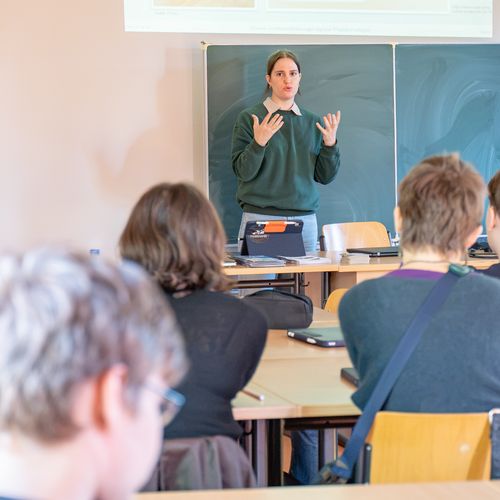
Hochschule Bremen (HSB) thrives on the people who study and work here, and who enrich the university as guests. In our ‘Three Questions for…’ series, we introduce some of them. Here: Dr Heike Tauerschmidt. She has headed the International Office for almost 20 years and has been at HSB since 1999. Consequently, Heike Tauerschmidt knows the history of HSB’s internationalisation like almost no one else. She is retiring at the end of June. A look back and a look ahead.
Ms Tauerschmidt, international engagement has a long tradition at HSB: it was one of the first universities in Germany to offer degree programmes with integrated study abroad placements. Today, HSB has more than 370 partnerships worldwide. How has internationalisation at HSB developed over the years?
Heike Tauerschmidt: You can roughly divide this period into two distinct phases: the heyday and the period of upheaval. I need to go back a bit here:
Until around 2014/15, the HSB held an outstanding position at national level due to its many international degree programmes and the associated above-average outgoing mobility. This also included the continuous (further) development of extensive measures to offer HSB students and international exchange students the best possible service and support. Furthermore, the expansion of the decentralised International Offices across all faculties consolidated close cooperation with the central International Office within the ‘Team Internationales’. During this period, strong links were also forged with other universities in Bremen, as well as the UAS7 Alliance with its liaison office in New York. Over the years, UAS7 has also developed into a politically influential voice in Germany.
The HSB’s period of growth is particularly evident in the annual funding it receives from the German Academic Exchange Service (DAAD): during this time, the HSB has managed to increase this funding by one million euros to 1.45 million euros – largely due to the sharp rise in Erasmus funding and the successful acquisition of project grants.
Then came a time of upheaval…
Yes, it has been dominated by the cross-cutting issue of digitalisation. Added to this were the refugee crisis and then the coronavirus crisis:
From around 2014, the IO, together with the decentralised IOs, stepped up the digitalisation of administrative processes for outgoing and incoming mobility. A highlight is undoubtedly the online shop, through which payment of semester fees for incoming students from third countries is processed, and which has since been extended to cover some payments by students at the HSB’s International Graduate Centre (IGC). Since 2021, the drive towards digitalisation has become a serious matter, as the contract for the new Erasmus programme period explicitly stipulates ‘Erasmus without Paper’ and, by signing it, we at the HSB have committed ourselves to implementing this. This is a tough nut to crack, one that cannot be tackled by the IO alone, but which affects the entire HSB. Fortunately, we have the active support of a competent colleague from the Vice-Rectorate for Digitalisation, Change Management and Diversity.
It was then the unique circumstances of the COVID-19 crisis that quickly propelled HSB to the next stage of development: namely, the realisation that international teaching can also work virtually. Together with our UAS7 partners, we were able to secure funding for the “UAS7 Virtual Academy” project, which focused on the implementation of so-called Collaborative Online International Learning (COILs) and helped to introduce this concept to HSB.
The refugee crisis also had an impact on the HSB, which joined the University of Bremen’s “In Touch” initiative at an early stage. Together, we offered refugees with an interest in academia informal access to the universities in Bremen. This led to the development of the Café International at the HSB – an event format for networking and exchange that remains successful to this day. The DAAD reacted swiftly and launched the “Welcome” and “Integra” funding programmes, designed to provide specialised support services and formal access to degree programmes. This was the catalyst for the joint initiative between the University of Bremen and the HSB to develop a pre-degree programme in Bremen with its own entrance examination for admission to Bremen’s public universities. The then Senator for Science, Prof. Dr Eva Quante-Brandt, supported this initiative from the very beginning. The result is the Academy HERE AHEAD, which since 2019 has also been accepting prospective students from third countries who do not have direct university entrance qualifications. This is undoubtedly a success story for the state of Bremen.
Some people say: HSB is already so international, so why join STARS EU now – a European alliance of nine universities funded by the EU since 2023?
STARS EU comes at exactly the right time, because working within this network propels HSB into the top tier of universities in Europe. Bremen University of Applied Sciences is one of 500 universities across Europe – and one of only eight universities of applied sciences in Germany that are entitled to bear the ‘European University’ seal. That is a major distinction. And this status as a ‘member of a European university alliance’ also improves our chances of securing further third-party funded projects at federal and EU level across all fields.
STARS EU is also having a positive impact on the university’s development: HSB is currently in the process of realigning its strategic direction and, as part of this, must also revise its internationalisation strategy – the key phrase being ‘from mobility to international competence’. For students, this means that their opportunities to acquire international competencies will expand many-fold, for example through virtual collaborative formats and options for short-term mobility via STARS EU. This makes studying abroad more inclusive.
I am also firmly convinced that participation in STARS EU will give a new boost to the sense of community at the HSB. All HSB members currently involved in STARS EU – already almost 50 lecturers and staff members – repeatedly emphasise how valuable and inspiring the cooperation with the eight European partners is and how it enriches their daily work. It is therefore well worth getting involved. Anyone interested is very welcome.
You are retiring at the end of June. What are your hopes for HSB’s international future, and what are you looking forward to in this new chapter of your life?
I hope that, with this new development, HSB will regain its former strength in internationalisation and once again become a beacon in Germany. These are truly exciting times, and I’m finding it quite difficult to say goodbye. But as the saying goes, you should leave when things are at their best. In any case, the joy of being able to devote more time to my family and friends and to pursue my hobbies without time constraints or having to prioritise – gardening, cooking (preferably with my own harvest), horse riding and the odd ‘home improvement’ project – outweighs everything else. Perhaps we’ll even get another dog. I certainly won’t be getting bored.