Jump directly to the page content
  • AULIS
  • CampInO
  • Webmail
  • Wi-Fi (eduroam)
  • Change password
  • Semester Dates
  • Account Activation
  • Prospective students For prospective students
  • First-semester students For first-semester students
  • International Students
  • Press and media For press and media
  • Job seekers
  • DE
  • Easy English
  • Dark Mode
  • Visual Help
  • Experience studying
    • Programmes
      • Bachelor
      • Master
      • International MBA & Master
    • Before your studies
      • Step by step to university
      • Orientation for prospective students
      • Application and admission
      • International applications
    • During your studies
      • First-semester students
      • Semester dates
      • Logins and portals
      • Formalities
      • Going abroad
      • Complementary offers for students
    • After your studies
      • Master's degree programmes
      • Career perspectives
      • Continuing education
      • Information for Alumni
      • Doctorates
    • All about studying
      • Student life
      • Student participation
      • Healthy through your studies
      • Mensa, canteens and cafeterias
      • Culture
      • Sports
    • Advice and support
      • Central Student Advisory Service
      • Doubting Your Studies
      • Finances
  • Experience research
    • Research and transfer profile
      • Strategic partnerships
      • Institutes
      • Research projects
    • Research and transfer clusters
      • Blue Sciences
      • Digital transformation
      • Quality of life
      • Aerospace
    • Early career researchers
    • Transfer and cooperation
    • Research Services
    • Start-up service & FreiRAUM@HSB
      • Makerspace
  • Experience continuing education
  • Experience HSB
    • News
      • Press Releases
      • News Items
      • Events
    • Faculties
      • School of International Business
      • School of Architecture, Civil and Environmental Engineering
      • School of Social Sciences
      • School of Electrical Engineering and Computer Science
      • School of Nature and Engineering
    • Organisation
      • University Management
      • Administration
      • Central Units
      • Inter-university units
      • Committees and representation of interests
    • Our profile
      • Mission Statement
      • Internationality
      • Equality
      • Diversity
      • Sustainability at HSB
      • Hochschule Bremen at a glance
    • Campus Life
      • People of HSB
      • Location and access
      • History
      • Culture
      • Sports and activities
    • Working at HSB
      • Get to know HSB
      • We are HSB!
      • UAS professorship
      • Job offers
      • Your application to HSB
      • Contact and advice
      • Any further questions?
    • Staff
    • HSB Merchandise
    • AULIS
    • CampInO
    • Webmail
    • Wi-Fi (eduroam)
    • Change password
    • Semester Dates
    • Account Activation
    • Prospective students For prospective students
    • First-semester students For first-semester students
    • International Students
    • Press and media For press and media
    • Job seekers
  • DE
  • Easy English
  • Dark Mode
  • Visual Help
Experience studying
  • Programmes
    • Bachelor
    • Master
    • International MBA & Master
  • Before your studies
    • Step by step to university
    • Orientation for prospective students
    • Application and admission
    • International applications
  • During your studies
    • First-semester students
    • Semester dates
    • Logins and portals
    • Formalities
    • Going abroad
    • Complementary offers for students
  • After your studies
    • Master's degree programmes
    • Career perspectives
    • Continuing education
    • Information for Alumni
    • Doctorates
  • All about studying
    • Student life
    • Student participation
    • Healthy through your studies
    • Mensa, canteens and cafeterias
    • Culture
    • Sports
  • Advice and support
    • Central Student Advisory Service
    • Doubting Your Studies
    • Finances
Experience research
  • Research and transfer profile
    • Strategic partnerships
    • Institutes
    • Research projects
  • Research and transfer clusters
    • Blue Sciences
    • Digital transformation
    • Quality of life
    • Aerospace
  • Early career researchers
  • Transfer and cooperation
  • Research Services
  • Start-up service & FreiRAUM@HSB
    • Makerspace
Experience continuing education
Experience HSB
  • News
    • Press Releases
    • News Items
    • Events
  • Faculties
    • School of International Business
    • School of Architecture, Civil and Environmental Engineering
    • School of Social Sciences
    • School of Electrical Engineering and Computer Science
    • School of Nature and Engineering
  • Organisation
    • University Management
    • Administration
    • Central Units
    • Inter-university units
    • Committees and representation of interests
  • Our profile
    • Mission Statement
    • Internationality
    • Equality
    • Diversity
    • Sustainability at HSB
    • Hochschule Bremen at a glance
  • Campus Life
    • People of HSB
    • Location and access
    • History
    • Culture
    • Sports and activities
  • Working at HSB
    • Get to know HSB
    • We are HSB!
    • UAS professorship
    • Job offers
    • Your application to HSB
    • Contact and advice
    • Any further questions?
  • Staff
  • HSB Merchandise
  1. Homepage
  2. Study
  3. European Studies: Law - Politics - Economics M.A./LL.M.: 2-Semester Programme

European Studies: Law - Politics - Economics M.A./LL.M.

2-Semester Programme

Study economics, law and politics in Europe for your leadership career

Who is this programme for?

Our two-semester master's programme is intended for applicants who hold a bachelor's degree with at least 240 ECTS in economics, politics, law or a closely related field.
With a solid academic background, you can progress directly into advanced studies and complete your master’s in a fast-track format.

Not sure whether your degree meets the 240 ECTS requirement? Check here first: Choose your track

Overview

Duration: 2 semesters (60 ECTS)

Start: 1 October

Language of instruction: English

Degree awarded: Master of Arts (M.A.) or Master of Law (LL.M.)

Tuition fees: None

Programme Structure

The two-semester master's programme is designed to provide in-depth specialisation, interdisciplinary skills and practical experience.
Semesters at Hochschule Bremen: winter semester followed by summer semester

  • Module 2.1 is divided into 3 sections, EU Institutions (50 %), Integration Theories (25 %) and Challenges of Integration (25 %).

    The section on EU-Institutions introduces the legal framework of the EU’s organisational structure, including the institutions’ tasks and powers and working procedures, as well as recent attempts of reform, and different levels of government.

    The section on Theories of European Integration and Multi-Level Governance looks more specifically at drivers of and impediments to the European integration process, the distribution of power and democratic legitimacy in the political system of the EU. It analyses the normative visions of good European integration in the light of climate change and digitalization, democratic legitimacy of EU integration and attempts to identify an ‘ideal’ multi-level governance system in the EU.

    The section on Current Challenges of EU Integration focusses namely on climate change and digitalization and its impact on both the public and the private sector.


  • Module 2.2 introduces the legal system of the EU, covering the sources of EU law, the ‘acquis communautaire‘, and general principles and fundamental values of EU Law. In addition, the relationship between the law of the EU and its Member States, the transposition of EU law into Member State law and the approximation of the law of the Member States are addressed.

    In substance, the module focusses on internal market law, in particular the fundamental freedoms, the digital internal market, sustainability requirements, basics of EU competition law, external trade law, and allows for an introduction into a specific field of EU law, e.g. EU Labour Law with specific regard to gender equality and diversity, European Environmental and Sustainability law or the legal framework of the digital internal market.

  • The module ‘European Economic Integration’ includes an introductory section (50 %) with a brief history of European – regional – economic integration and the essentials of economic integration theory and practice, including its economic foundations (single Market, in particular the fundamental freedoms) and key policy areas, such as the industrial, external trade and environmental policy.

    Further sections offered according to students’ choices (25 % each) will be a more in-depth study of Competition Policy in the EU, Transition Economies (analysing the continued impact of the transition of centrally planned economies to free markets) or Current Economic Affairs in the EU.

  • The EU funding programmes are highly in demand in practice. This module gives an insight into the basics of EU funding, its influence on policy development and an overview over the current programming period, looking at the EU funding programs for

    • research (namely Horizon),
    • regional policy (namely European Fund for Regional Development EFRD),
    • business and economy,
    • education (Erasmus+),
    • further specific programs e.g. regarding digital autonomy, European Social Fund (ESF), Connecting Europe Facility (CEF) etc.


    The practice part on applying for Funds in the EU is based on a recently published call for proposals and offers three practice workshops:

    • preparing the project proposal,
    • treating the financial questions in setting up the financial plan,
    • defining the selection criteria.


    Der Praxisteil zur Beantragung von Fördermitteln in der EU basiert auf einem kürzlich veröffentlichten Aufruf zur Einreichung von Vorschlägen und bietet drei Praxis-Workshops:

    • Vorbereitung des Projektvorschlags,
    • Behandlung der finanziellen Fragen bei der Erstellung des Finanzplans,
    • Definition der Auswahlkriterien.
  • Modules 2.5 and 2.6 are alternative modules, allowing students to focus on either law or interdisciplinary study. Both include the Brussels Intensive Seminar as their Unit 1, with a focus either on law or on interdisciplinary visits. Following a briefing session on the workings of the EU in practice with its overall structure and institutions and diplomatic, political, commercial and/or civil society organisations or associations or other actors observing and interacting with the EU institutions the excursion to Brussels offers visits to the EU institutions, organisations and associations, with practitioner/experts presentations on the work of their institution and on topical EU issues currently in the focus of their work, and the chance for a discussion with the experts. Visits usually include:

    • EU Commission
    • EU Council
    • EU Parliament
    • Committee of the Regions
    • Economic and Social Committee
    • Representative of the Free Hanseatic City of Bremen to the EU
    • Think Tank
    • Transparency International
    • Commercial and/or Ecological lobbying organisations.


    The second unit in the law module 2.5 builds on module 2.2 and focusses on Energy Law in the European Union, offering an in-depth study of a very topical and highly regulated area of EU law and its operation in practice. Based on case studies and mock negotiations it introduces key principles and objectives, the impact of EU energy policy and law on member states and non-EU countries, the legal framework governing the whole value chain, namely regulatory instruments used to promote security of supply, environmental protection and competition, and legal challenges under the fragmented regime of EU energy law and policy.


  • Modules 3.1 and 3.2 are alternative modules, giving students the choice as to whether they want to focus more on the public sector and perspectives in EU institutions or public administration or government (3.1), or whether they are aiming at doing business in Europe, focussing on the private sector (3.2).

    Module 3.1 consists of two units of equal weight. Unit 1 considers the EU as a Global Player in external relations, trade, sustainability and development policy, including:  

    • The European Union`s Common Commercial Policy, Neighbourhood and Development Policy and Common Foreign and Security Policy (CFSP),
    • EU relations to the ”near abroad”: neighbourhood programs and relations
    • the EU´s foreign relations with the developing world
    • EU relations with the Americas: EU and USA, NAFTA, MERCOSUR and Latin America
    • EU relations with East and Southeast Asia: ASEAN, ASEM, SAARC

    Unit 2 offers an in-depth study of EU Decision making, how to influence it and how it is or should be communicated: EU Law making processes – formally and informally, Stakeholders, NGOs, LOBBYING in the EU, EU communication and Member State communication on the EU, and public opinion and civil participation.  

  • Modules 3.1 and 3.2 are alternative modules, giving students the choice as to whether they want to focus more on the public sector and perspectives in EU institutions or public administration or government (3.1), or whether they are aiming at doing business in Europe, focussing on the private sector (3.2).

    Module 3.2 consists of two units of equal weight. Unit 1 considers management and challenges of doing business in the EU and beyond, including market-oriented business strategy, customer and consumer behaviour, tools and approaches for country market related research.

    Unit 2 adds the legal framework for doing business in Europe, i.e. EU business law governing legal relationships between private entities, namely

    • principles of contractual freedom and private autonomy
    • basics of company law in the EU
    • International contract law
    • basics of the law governing product liability and liability for environmental damage

    These will be applied in case studies in exemplary topical fields, such as

    • digital internal market law,
    • environmental protection and sustainability in internal market law,
    • consumer protection law (e.g. rules on unfair contract terms, product safety, consumer rights),
    • regulatory law,
    • intellectual property law.
  • Module 3.3 adds a flexible module to allow for focus according to student choices. As a container module on Current Issues of EU law, politics and economics it should relate to, e.g., Climate Change, sustainable development and supporting framework, social policy, migration, digitalisation, EU in a multi-polar world, or other current topic of the EU. Students should either choose from the university master modules of other courses of study related to the EU, participate in the challenge modules offered in the STARS EU European University with HSB’s participation, contribute a project to the Europe Weeks of the Bremen Government, prepare and present a Conference Contribution (e.g. at a DTX cluster Conference on the EU Green Deal), or join an excursion (e.g. offered by the EU institutions or the Bremen government) with relevant contents. In order to be recognized, the chosen module needs to be related to EU issues of a legal, political or economic nature.

    The module framework includes an introduction to current issues of EU law, politics and economics, plus a supervised choice of a module,  and supervised participation in chosen module, as well as a ‘Lessons learned’ session.

  • The Master Thesis module consist of a Master Thesis Colloquium, guiding students to the choice of their field of research and, finally, Master Thesis topics. The colloquium offers support during the writing of the thesis namely with regard to planning and doing research, academic writing/no-plagiarism rules etc.

    Students write the Master Thesis with individual coaching by the supervisors. Students will have to work intensively at a research project, case study or literature research, from the fields of law, politics or economics, or interdisciplinary, and put the results of their research in writing in the form of an academic paper.

Module catalogue (German)

  • Modulhandbuch MES (Stand: 2024) (PDF, 571 KB, File does not meet accessibility standards)

Examination regulations (German)

  • MPO MES 2025 (PDF, 385 KB, File does not meet accessibility standards)
  • General examination regulations for master degree programmes

Application

Does this sound like the right fit for you? If you are eager to begin your journey in European Studies, here is when and how to apply.

Applications are accepted during this period:

  • 1 June – 15 July (for winter semester / programme starts on 1 October)

How to complete your application – step by step

  • You can apply for the three-semester track if you meet the following criteria:

    • A bachelor’s degree with at least 240 ECTS (or equivalent workload)
    • A final grade of 2.5 or better in the German system (or equivalent international grade, e.g. ECTS grade A or B)
    • C1-level English proficiency demonstrated through TOEFL, IELTS or an equivalent test – or your bachelor's degree, if it was taught in English
    • No German language skills required – the programme is fully taught in English

    For international students, a cumulative grade point average (CGPA) of at least 3.00/4.00, 7.50/10.00, an upper first-class degree with distinction, or a percentage above 70 % is generally indicative of meeting the grade requirement.

    • However, the Vorprüfungsdokumentation (VPD) issued by uni-assist (see step 4) is the decisive factor for admission.
  • You will need:

    • Your bachelor's certificate and transcript
    • Proof of English language proficiency (if applicable)
    • A copy of your ID card or passport
    • Curriculum Vita and letter of motivation (recommended for international applicants)
    • Applicants from India, Vietnam and China: APS certificate
    • Vorprüfungsdokumentation VPD from uni-assist
    • For non-EU nationals: a copy of the visa for stays in Germany
  • Applicants from India, Vietnam or China must also submit an APS certificate issued by the Academic Evaluation Centre (APS) in their home country.

    Please apply for the APS certificate well in advance – it is required for enrolment at German universities.

    • APS India
    • APS Vietnam
    • APS China
  • If you obtained your bachelor's degree outside Germany, you must request a Vorprüfungsdokumentation (VPD) from uni-assist before applying.

    This document confirms that your degree qualifies you for admission to a master's programme in Germany.

    • Apply for your VPD as early as possible – the process may take 4–6 weeks.
    • If you are still waiting for VPD, please upload proof of your VPD application.

    Get your VPD here

  • Once you have received your VPD and the APS certificate (if applicable), you can apply via the HSB online portal:

    • Make sure to select the correct track (three-semester, Electronics Engineering M.Sc.)!
    • Please use a valid e-mail address and check it regularly.

    Apply through our platform CampInO - available only during the application periods

    Help and support

  • The admission procedure begins once the application deadline has passed. If your application status changes, you will be notified by e-mail. Please check your e-mails regularly – HSB will contact you only this way!

    Accepting a place and enrolling at HSB

Getting Ready to Study

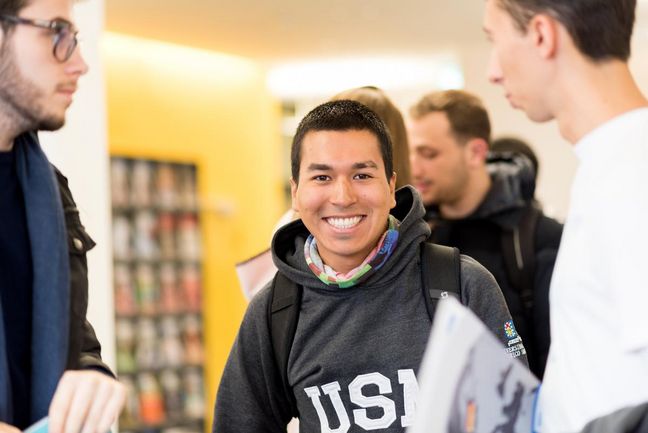
Smiling student in a university hallway, surrounded by peers.

© Sabrina Peters

Before your studies begin, there are a few important things to take care of – especially if you are moving to Germany:

  • Apply for a student visa (if required)
  • Arrange accommodation in Bremen
  • Take out health insurance
  • Plan your arrival in time for orientation and the start of lectures

We are here to support you:

International Office: Assistance with study-related matters and everyday life during your stay in Germany: advice and support for international students

Contact

Questions about the programme or the application process? We are happy to assist you.

Programme Director

Porträtfoto Christiane Trüe

Prof. Dr. Christiane Trüe
Professur für öffentliches Recht, insb. Allg. Verwaltungsrecht und Staats- und Verfassungsrecht
+49 421 5905 4762
Email
Programme Coordinator

Auf dem Bild ist Corinne Trümpler zu sehen. Sie hat hellblondes kinnlanges Haar. Sie trägt ein hellblaues Shirt und einen dunklen Blazer.

Corinne Trümpler
Programme & International Coordinator
+49 421 5905 4805
+49 176 1514 0186
Email

  • Main page of the degree programme
  • Visit our Instagram profile Visit our Instagram profile
  • Visit our Facebook page
  • Visit our YouTube channel
  • Visit our Xing profile
  • Visit our LinkedIn profile
  • Contact
  • Cookies
  • Location and access
  • Career
  • Legal notice
  • Data privacy policy
  • Accessibility

© HSB - Hochschule Bremen 2026