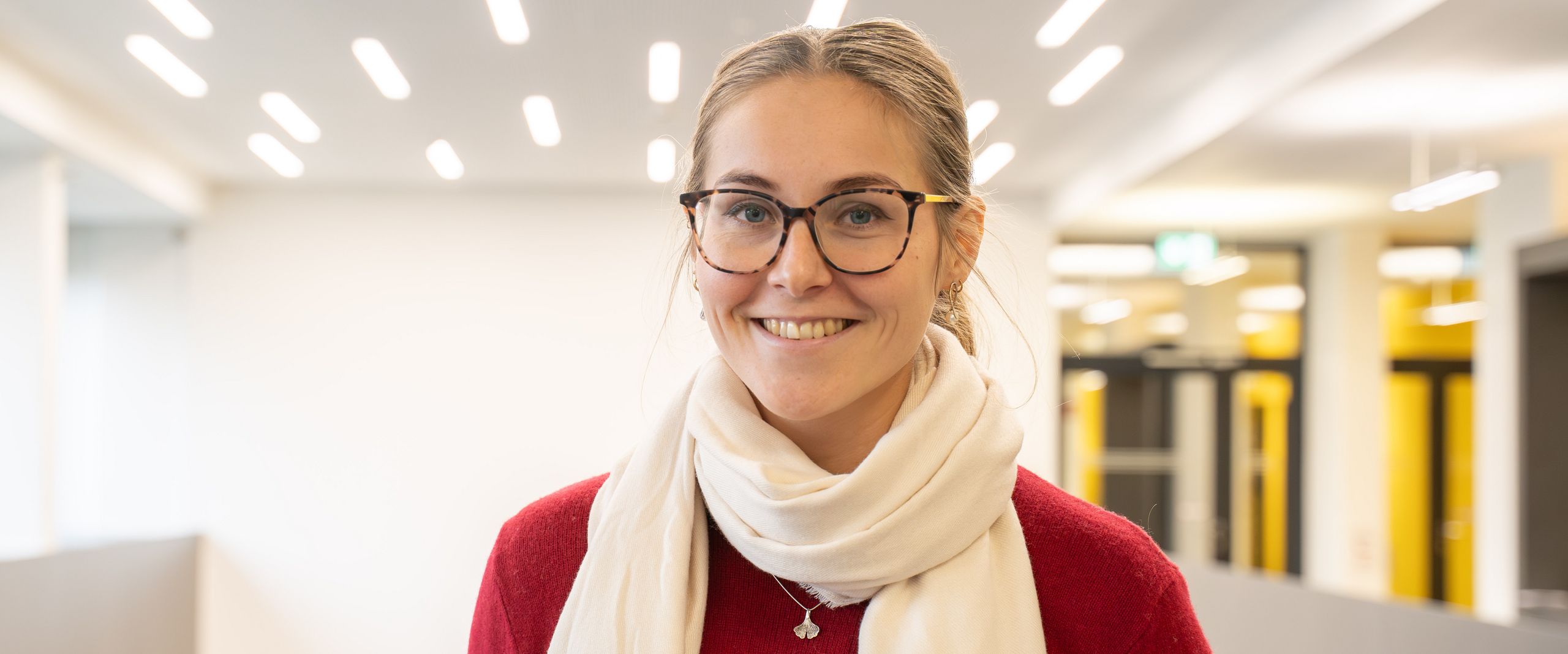
Hochschule Bremen (HSB) thrives on the people who study, work and enrich the university as visitors. In our “Three Questions for…” series, we introduce some of these people. Here: Johanna Günther. The 27-year-old is responsible for Student Health Management at HSB – SGM for short. The project, which is funded by third-party grants, is based within the Central Student Advisory Service. To provide students with the most suitable and diverse range of services possible, the SGM works closely with the General Student Committee (AStA), the StudiumPlus team at the Centre for Teaching and Learning (ZLL), the Occupational Health Management team and other departments at the HSB, as well as the Psychological Counselling Service. In this interview, the HSB staff member explains how students benefit from Johanna Günther’s work and what you can do yourself to lead a healthy life.
Mr Günther, what do people need these days to study in a healthy way?
In my view, there are two aspects at play here: firstly, there needs to be a suitable environment at universities. After all, healthy studying only works in conditions that promote well-being. I can see that lecturers at the HSB and administrative staff are very committed to this.
Social integration within the university context and financial security are also crucial factors. These are currently among the biggest sources of stress. And last but not least, we need a university culture in which it is clear that behind every matriculation number there is a person who wants to perform well, but who is not a machine and also needs rest and balance.
On the other hand, part of the responsibility lies with the students themselves – the key term here is health literacy: those who understand their own stress patterns, resources and risk factors can make informed decisions in their day-to-day student life. For example: what constitutes healthy routines? What helps me maintain a balance? How can I tell when things are getting too much for me, and how should I respond? How do I make the right decisions for my health in the demanding day-to-day life of university? Health is complex and highly individual. In my view, the key lies in finding your own definition, reflecting on it time and again, and being able to benefit from the insights gained. After all, what helps one person may be counterproductive for another.
How can you support students through the services you offer?
As a relatively new face at HSB, this is precisely where I’m focusing my efforts with Student Health Management: the services offered by Student Health Management are designed to improve students’ health literacy. We focus on four areas – physical, mental and social health, as well as healthy learning. Whether it’s a workshop, a walk-in clinic or an action day: we provide practical tips for everyday life – from stress management, mindfulness and time management to nutrition, sleep and digital balance, right through to regular sports and exercise programmes – which you can try out straight away so that you don’t have to put your health on the back burner whilst studying.
At the same time, we look at the wider context. To do this, we need feedback from students – after all, they know best where the needs lie and what changes could make their studies easier. Structural changes may be more complex and often take longer, but they have far-reaching implications. A prerequisite for this is that health is taken seriously as a cross-cutting issue at the HSB.
What do you particularly enjoy about your work?
Firstly, the target group: students are the designers of the future. Developing student health management at the HSB with them and for them means driving forward the long-term development of health awareness at the HSB and seeing the results of that. I really enjoy both of these things. Secondly, the collaboration: health has countless facets. Through dialogue with students, lecturers and teaching stuff, I am constantly discovering new perspectives. This joint ‘exploring’ and, in some cases, redefining of the health spectrum makes my work very vibrant and meaningful to me.
Thirdly, the creative process: Student Health Management has only been around for a few years. Creating something ‘from scratch’ – a single workshop, a series of events, a whole management system centred on student health – and then seeing how it is received is incredibly motivating.