Research at an international level requires uninterrupted time. Alongside the day-to-day teaching workload at universities, it is virtually impossible to see large-scale empirical projects through to completion. A research semester provides the space needed to analyse data thoroughly, document findings and discuss them with colleagues at conferences and during research visits. And the great thing about it is that everything produced during this time is subsequently fed back into teaching and the university. Dr Stefan Veith, Professor of Business Administration at Faculty 1 – Economics at Bremen University of Applied Sciences (HSB) since 2019, explains in an interview what he did during his research semester and how not only he, but also his students and colleagues, benefit from it.
The focus was on three empirical projects, all of which revolve around the same fundamental question: do new international accounting standards really make insurance companies’ annual reports more meaningful to outsiders, and is this reflected in the stock markets? Specifically, the research centred on two major reforms that European insurers have recently been required to implement. I investigated whether the reports have become more informative as a result and whether investors actually incorporate the new information into their valuations.
Definitely internationally. For the analysis, I examined European insurance groups over a period of around twenty years and compared them with companies that were not affected by the reforms. My analysis extends beyond Europe, as in one of the projects I compare the European practice of publishing risk information with that of the US and Japan, where the same information remains confidential. My co-authors are also spread across the globe: in Canada, the US, Japan and the UK. However, the semester wasn’t just international in terms of content; it also took me abroad myself, most notably for three weeks at a US university.
In the US, I spent three weeks at the University of Iowa: at the Tippie College of Business there. Whilst there, I worked intensively with my co-author Cameron Ellis on one of the papers, which we were able to almost complete during that time, and I presented my research at the faculty’s research seminar.
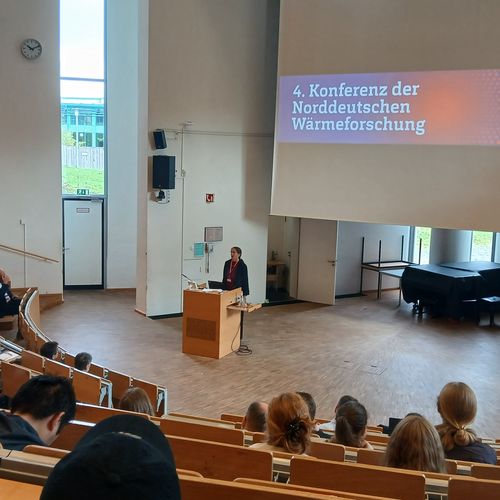
I also attended several conferences: the think17 conference in Bremen; an online conference in Indonesia, where I gave an invited keynote speech; and a finance conference in Karviná, the Czech Republic, where I also served as a panellist.
That’s right; as part of an EU-funded project, I am supporting the Algerian Investment Promotion Agency in setting up a performance measurement system. I have been to Algiers on several one-week assignments for this purpose. Partnerships like this bring European administrative expertise to other countries and tie in well with my research into the public sector.
The picture is nuanced, and that is precisely what makes it so fascinating. One key finding is that the balance sheet – that is, the overview of assets and liabilities – has become significantly more informative as a result of the new rules. On the stock market, it is also evident that investors’ price reactions are systematically linked to certain balance sheet characteristics. So investors are looking very closely.
The comparison between Europe and the rest of the world is particularly revealing. In Europe, insurers have been required to publish their risk profiles for several years, whilst in the US and Japan they only report these confidentially to the regulators. This difference has a significant impact: where risk reports are accessible to everyone, companies’ default risk falls noticeably, and the market is better informed. Life insurers benefit the most, as their business is particularly complex and difficult to understand.
And contrary to what one might fear, this transparency does not make it more expensive for companies to raise capital. The data actually suggests a reduction in costs, though this is not because investors are suddenly valuing companies more highly. Rather, it is linked to more subdued expectations regarding future earnings; in other words, it stems from the revenue side. This work is still ongoing, but the direction is clear: public transparency brings genuine added value that internal controls and purely confidential supervision alone cannot provide.
The benefits are very tangible: I have adapted my research projects into real-world case studies for teaching, and they were already incorporated into the Business Analytics and ESG Accounting modules in the summer semester of 2026. In these modules, students work with real research questions and real data rather than textbook examples. The faculty is also interested in the methods, which can be applied beyond the field of insurance, and the new international contacts open up opportunities for guest lectures and joint projects in the coming semesters.