Jump directly to the page content
  • AULIS
  • CampInO
  • Webmail
  • Wi-Fi (eduroam)
  • Change password
  • Semester Dates
  • Account Activation
  • Prospective students For prospective students
  • First-semester students For first-semester students
  • International Students
  • Press and media For press and media
  • Job seekers
  • DE
  • Easy English
  • Dark Mode
  • Experience studying
    • Programmes
      • Bachelor
      • Master
      • International MBA & Master
    • Before your studies
      • Step by step to university
      • Orientation for prospective students
      • Application and admission
      • International applications
    • During your studies
      • First-semester students
      • Semester dates
      • Logins and portals
      • Formalities
      • Going abroad
      • Complementary offers for students
    • After your studies
      • Master's degree programmes
      • Career perspectives
      • Continuing education
      • Information for Alumni
      • Doctorates
    • All about studying
      • Student life
      • Student participation
      • Healthy through your studies
      • Mensa, canteens and cafeterias
      • Culture
      • Sports
    • Advice and support
      • Central Student Advisory Service
      • Doubting Your Studies
      • Finances
  • Experience research
    • Research and transfer profile
      • Strategic partnerships
      • Institutes
      • Research projects
    • Research and transfer clusters
      • Blue Sciences
      • Digital transformation
      • Quality of life
      • Aerospace
    • Early career researchers
    • Transfer and cooperation
    • Research Services
    • Start-up service & FreiRAUM@HSB
      • Makerspace
  • Experience continuing education
  • Experience HSB
    • News
      • Press Releases
      • News Items
      • Events
    • Faculties
      • School of International Business
      • School of Architecture, Civil and Environmental Engineering
      • School of Social Sciences
      • School of Electrical Engineering and Computer Science
      • School of Nature and Engineering
    • Organisation
      • University Management
      • Administration
      • Central Units
      • Inter-university units
      • Committees and representation of interests
    • Our profile
      • Mission Statement
      • Internationality
      • Equality
      • Diversity
      • Sustainability at HSB
      • Hochschule Bremen at a glance
    • Campus Life
      • Location and access
      • History
      • Culture
      • Sports and activities
    • Working at HSB
      • Get to know HSB
      • We are HSB!
      • UAS professorship
      • Job offers
      • Your application to HSB
      • Contact and advice
      • Any further questions?
    • Staff
    • AULIS
    • CampInO
    • Webmail
    • Wi-Fi (eduroam)
    • Change password
    • Semester Dates
    • Account Activation
    • Prospective students For prospective students
    • First-semester students For first-semester students
    • International Students
    • Press and media For press and media
    • Job seekers
  • DE
  • Easy English
  • Dark Mode
Experience studying
  • Programmes
    • Bachelor
    • Master
    • International MBA & Master
  • Before your studies
    • Step by step to university
    • Orientation for prospective students
    • Application and admission
    • International applications
  • During your studies
    • First-semester students
    • Semester dates
    • Logins and portals
    • Formalities
    • Going abroad
    • Complementary offers for students
  • After your studies
    • Master's degree programmes
    • Career perspectives
    • Continuing education
    • Information for Alumni
    • Doctorates
  • All about studying
    • Student life
    • Student participation
    • Healthy through your studies
    • Mensa, canteens and cafeterias
    • Culture
    • Sports
  • Advice and support
    • Central Student Advisory Service
    • Doubting Your Studies
    • Finances
Experience research
  • Research and transfer profile
    • Strategic partnerships
    • Institutes
    • Research projects
  • Research and transfer clusters
    • Blue Sciences
    • Digital transformation
    • Quality of life
    • Aerospace
  • Early career researchers
  • Transfer and cooperation
  • Research Services
  • Start-up service & FreiRAUM@HSB
    • Makerspace
Experience continuing education
Experience HSB
  • News
    • Press Releases
    • News Items
    • Events
  • Faculties
    • School of International Business
    • School of Architecture, Civil and Environmental Engineering
    • School of Social Sciences
    • School of Electrical Engineering and Computer Science
    • School of Nature and Engineering
  • Organisation
    • University Management
    • Administration
    • Central Units
    • Inter-university units
    • Committees and representation of interests
  • Our profile
    • Mission Statement
    • Internationality
    • Equality
    • Diversity
    • Sustainability at HSB
    • Hochschule Bremen at a glance
  • Campus Life
    • Location and access
    • History
    • Culture
    • Sports and activities
  • Working at HSB
    • Get to know HSB
    • We are HSB!
    • UAS professorship
    • Job offers
    • Your application to HSB
    • Contact and advice
    • Any further questions?
  • Staff
  1. Homepage
  2. Easy English

Information in Easy English

Welcome

You are on the website
of Hochschule Bremen.

Studierende vor dem Eingang des AB-Gebäudes auf dem Campus Neustadtswall.

The main entrance to Hochschule Bremen

© HSB - Sabrina Peters

What is Hochschule Bremen?

Hochschule Bremen is also known as HSB.

Bremen is a city in the north of Germany.

A university of applied sciences is 
a higher education institution for adults.

People can learn a great deal 
at a university of applied sciences.

People also say: People study 
at a university of applied sciences.

When people study, they are called: students.

The teachers of students are called: lecturers.

The lecturers teach the students.

To do this, the students attend lectures and seminars
on a specific topic.

Researchers also work at HSB.

People also say: they conduct research.

Conducting research means:
finding out new things.

Who can study at HSB?

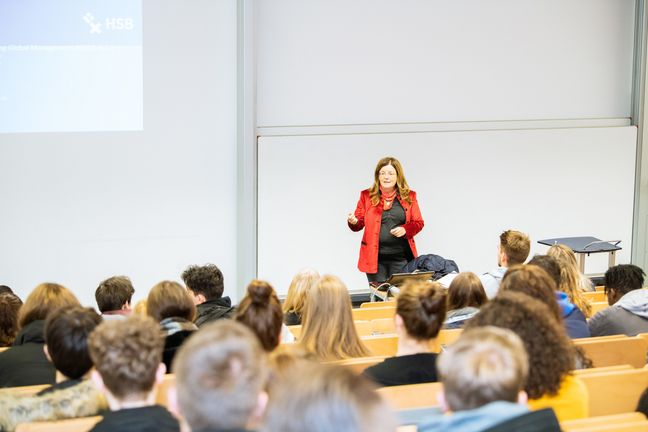
A lecturer in a lecture hall full of students

A lecturer in a lecture hall full of students

© HSB - Marcus Meyer

To study at HSB,
you need: the General Higher Education Entrance Qualification.

That’s the long name for: the A-levels.

Or you need the Vocational Higher Education Entrance Qualification.

Some people have already worked 
in a profession for a few years.

Sometimes that’s enough
to study at the HSB.

What students do

Students choose a subject for their studies.

These subjects are called degree programmes.

HSB offers more than 70 degree programmes.

At HSB, you can choose study programmes from 5 fields:

Economics

Here, students learn a lot about the economy.

Economics is everything to do with money.

For example, they learn:

How to sell things.

How to run a company.

Architecture, Civil 
and Environmental Engineering

Here, students learn a lot 
about buildings and the environment.

For example, they learn:

How to build buildings.

How electricity comes out of the socket.

How water comes out of the shower.

How to do good for nature.

Social Sciences

Here, students learn a lot 
about how people live together.

For example:

How to ensure
that everyone is treated equally.

How to help people
who are facing difficulties.

How to engage in politics.

Electrical Engineering 
and Computer Science

Here, students learn a great deal about technology.

They can test their knowledge in laboratories.

For example:

How to build a computer.

How to build mobile phones.

How satellites work.

Nature and Technology

Students learn a lot about machines here.

They learn how to build them.

And how to control them.

For example:

How to build a ship.

How to steer a ship.

How to build an aeroplane.

How to fly an aeroplane.

They also learn
how to protect the environment.

Once you have completed your studies, 
you will have a degree.

This may be a degree known as:

Bachelor.

A Bachelor’s degree programme 
takes around 3 years to complete.

It may also be a degree known as:

Master.

A Master’s degree programme 
takes around 1 to 2 years to complete.

What makes Hochschule Bremen special

Hochschule Bremen is practice-oriented.

This means:

Students put their knowledge into practice.

To do this, they work with people 
outside the university.

They also undertake work placements.

This means they get to try out a profession.

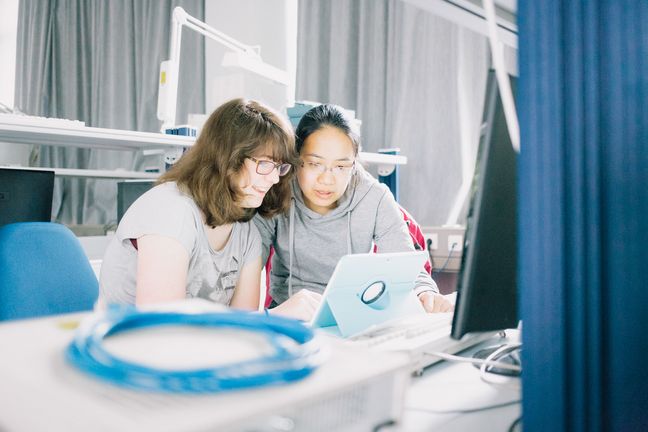
Two students work on a laptop in a laboratory

Two students work on a laptop in a laboratory

© HSB - Sven Stolzenwald

There are laboratories at HSB.

These are rooms where students 
can put their knowledge to the test.

Researchers can also 
put their knowledge to the test there.

For example, there is:

  • The Robotics Laboratory
    There, robots are shown
    what they are supposed to do.
  • The Young Computer Science Laboratory
    That’s where computers are studied.
  • The Aerospace Laboratory
    There, the focus is on aeroplanes, 
    for example.

HSB is an international university.

This means that it works together 
with other universities around the world.

Students at HSB can study 
in other countries.

People from other countries 
can study at HSB.

HSB offers a wide range of 
good international programmes.

Equality is an important value at HSB.

Equality means: All people are equal.

And all people have the same rights.

At HSB, everyone is treated equally.

This is important to us.

HSB has buildings

at four locations in Bremen.

How to contact HSB

You can give us a call.

Here is our telephone number: +49 421 5905-0

You can write to us.

Here is our address:

Hochschule Bremen
Neustadtswall 30
28199 Bremen

You can send an email to: presse@hs-bremen.de

Help for this website

The HSB logo in the main menu

The HSB logo in the main menu

There is a lot of information on this website.

We want to help you

find everything.

The logo

You will find the HSB logo at the top of every page.

It is located in the top-left corner.

If you click on it,

you will be taken to the home page.

The main menu

Screenshot of the main menu of the HSB website

Screenshot of the main menu of the HSB website

You will always find the main menu 
at the very top of every page.

The main menu is always the same.

It lists the most important pages 
on the website.

It is useful
for navigating
from one page
to the next.

There are various topics.

For example, there are:

  • Study
  • Research
  • Continuing Education

Sub-items in the main menu

The expanded main menu of the HSB website, showing sub-sections under the ‘Stud’ section.

Sub-items in the main menu relating to studying.

Each topic has sub-items.

To view the sub-items,
you can click on a topic.

For example:

The ‘Study’ topic has the sub-item:

Before your studies

There you will find:

  • Information for prospective students
  • Information on applying

To access the pages,
you can click on a sub-item.

Search box

Screenshot of the search box in the main menu of the HSB website

Screenshot of the search box in the main menu of the HSB website

You will find the search box 
at the top right.

You can search 
for a specific word here.

Click on the box.

Type the word you are looking for
into the box.

Press the Enter key.

The search results 
will now appear.

The footer

Screenshot of the footer menu of the HSB website

Screenshot of the footer menu of the HSB website

The footer is at the bottom of every page.

The footer is always the same.

There you will find, for example:

Social media

There you can see news from HSB.

And interact with others.

Contact

There you can see our contact details.

Legal notice

This section explains who created the website.

Data privacy policy

This section explains

what we do with your data.

For example:

If you have given us your email address.

To go to a website,

you can click on a topic.

Accessibility statement

Everyone should be able to use
websites and apps easily.

This should be true for all people.
For example for:

  • blind people
  • deaf people
  • people who cannot move all their fingers

That is why websites and apps
should be accessible.

This text explains: What is an accessibility statement?
And where can you complain

  • if a website is not accessible?
  • if an app is not accessible?

Rules in the law

Since 23 September 2020,
this rule applies:

Public institutions must have
an accessibility statement
for their websites and apps.

This is written in EU Directive 2016/2102.

EU directives apply to all countries in the EU.

The countries must create their own laws 
based on these rules.

In Germany, the law is called BITV 2.0.

The state of Bremen must follow this law too.

What are public institutions?

Public institutions work for the government
of a federal state
or for the national government.

Public institutions are, for example:

  • offices and authorities
  • some public housing companies
  • schools and some daycare centers

The tax office is a public institution, for example.

Public institutions also include organisations
that receive almost all their money from the state.

For example:

  • some museums, libraries and theaters
  • some swimming pools and sports centers

A supermarket, for example,
is not a public institution.

What is the accessibility statement?

The accessibility statement is a text.

This text is
on all websites of public institutions
in all apps of public institutions.

Here we only say “websites.”
The accessibility statement explains:

  • How accessible is the website?
    Experts can check this.
    The public institution can also check it itself.
  • Are there still barriers on the website?
    Then there must be a list of these barriers.
  • Maybe not the whole website has to be accessible.
    There can be exceptions.
    Then there must be a list of these exceptions.
    Important:
    The public institution cannot decide the exceptions alone.
    There are strict rules for exceptions.
  • The statement must also include the date when it was written.
    The date must not be older than one year.

Public institutions must check every year:
How accessible is our website?

Then they must write a new accessibility statement.

Report barriers

Do you want to use the website
but cannot
because there are still barriers?

Then you can complain.

The accessibility statement says
where you can complain.

You can complain about barriers
on this website here:

Email: redaktion@hs-bremen.de

You can complain about these things:

  • There are barriers on the website
    and they are not listed in the accessibility statement.
  • You need information from the website
    but the information is not accessible.
    For example:
    Your computer cannot read 
    an important PDF file aloud.
  • The accessibility statement is 
    older than one year.

The public institution has 2 weeks
to answer you.

Does the answer take longer than 2 weeks?

Or does the answer not help you?

Then you can complain to this office:

Central Office for Accessible Information Technology
Am Markt 20 28195 Bremen
Phone: +49 421 361 181 87
Email: office@lbb.bremen.de

The Central Office checks your complaint.

The Central Office then speaks with the public institution. 

And the Central Office sets a deadline for the public institution.

By this deadline the barriers must be removed.

If the public institution does not follow the deadline,
a mediation office talks with them.

Important:
You do not have to pay anything:

  • not for the work of the Central Office
  • not for the work of the Mediation Office

This text gives information about the accessibility statement. 

Because everyone should know which rights they have.

Do you use websites or apps of a public institution?

But there are problems with accessibility?

Then also read the accessibility statement
on the website or in the app.

In the statement you find information about where you can complain.

You must first complain to the public institution.
Only then can the Central Office help you.

Here you can find the accessibility statement of this website: Accessibility statement

German Text in Easy Language: © Büro für Leichte Sprache, Lebenshilfe für Menschen mit geistiger Behinderung Bremen e.V., 2020.

  • Visit our Instagram profile Visit our Instagram profile
  • Visit our Facebook page
  • Visit our YouTube channel
  • Visit our Xing profile
  • Visit our LinkedIn profile
  • Contact
  • Cookies
  • Location and access
  • Career
  • Legal notice
  • Data privacy policy
  • Accessibility

© HSB - Hochschule Bremen 2026