Hochschule Bremen - City University of Applied Sciences (HSB) lives off the people who study, work and enrich it as guests. In our section ‘People at HSB’ (formerly ‘Three Questions for’), we introduce some of them. Here: designer Janina Ebner. The HSB employee is currently contributing her skills and experience to the European university alliance STARS EU. In this interview, she explains what a pavilion in Tenerife has to do with it.
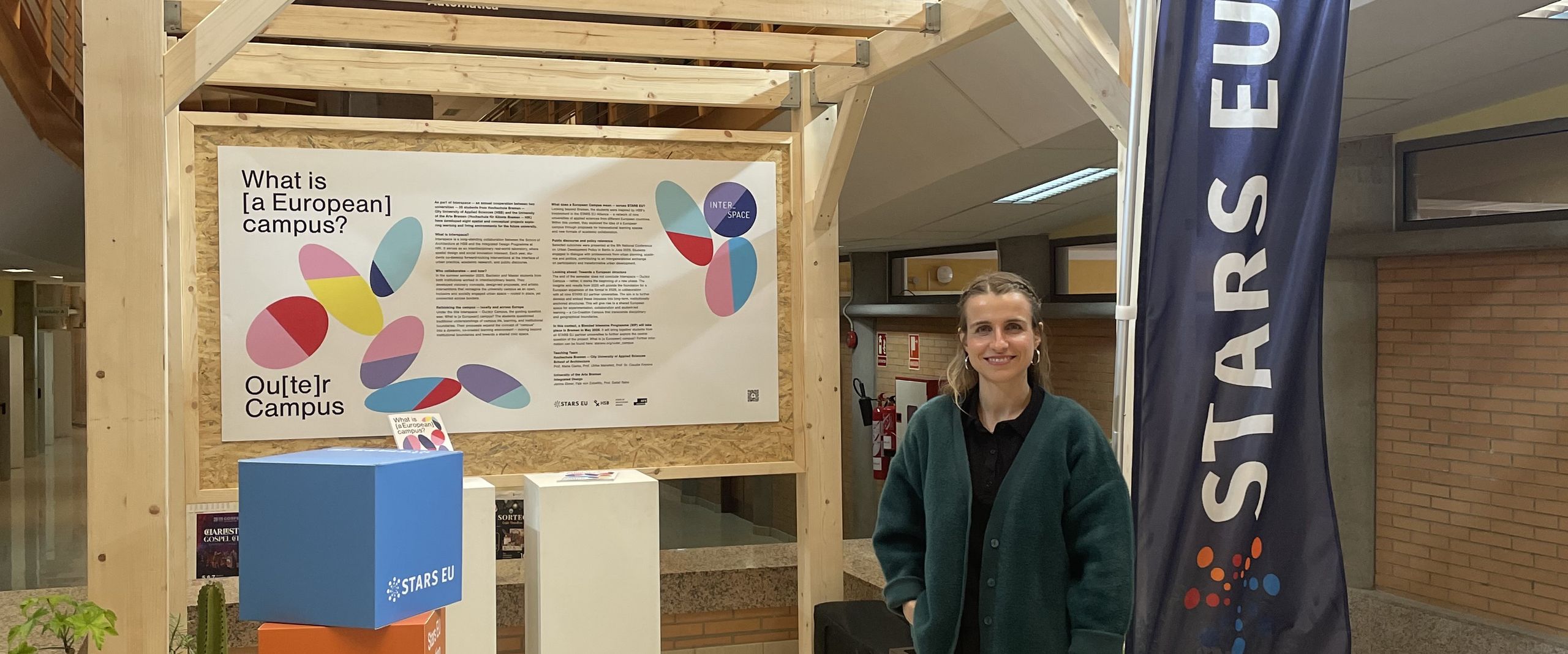
Ms Ebner, the photo shows you in a pavilion located in the foyer of a building at the University of La Laguna (ULL) in Tenerife. Tell us more about it.
The pavilion is the result of ‘Interspace – Ou[te]r Campus’, an established teaching and real-world laboratory format that the School of Architecture Bremen (HSB) and the Integrated Design programme (Bremen University of the Arts, HfK) carried out together with students. In the summer semester of 2025, we closely linked the format to the European university network STARS EU. In addition to myself, the format was accompanied by colleagues from the School of Architecture Bremen (HSB): Professor Ulrike Mansfeld, Prof. Maria Clarke and Prof. Dr. Claudia Kromrei, as well as colleagues from the University of the Arts Bremen (HfK): Prof. Detlef Rahe and Falk von Zobeltitz. The starting point was the key question: ‘What is [a European] campus?’ – in other words, how can a campus be conceived as a shared, co-creative space that enables cross-location collaboration, exchange and belonging within a European alliance?
The project has resulted in eight spatial and conceptual works. The pavilion shown in the photo is entitled UNI.KIT and was developed by the project group DeryaKuziak, Marlene Laurösch, Jalina Oetjen and Amon Osterkamp (students at the School of Architecture Bremen). UNI.KIT is not a single object, but rather a modular and transferable concept: the manual, plans and defined elements can be shared within the STARS EU network, allowing partners to implement the pavilion locally using their own resources, materials and adaptations.
Why is the first prototype located in La Laguna, Tenerife?
The University of La Laguna is a STARS-EU partner. It was chosen as the first test site to put the system's transferability to the test in practice. Based on the documentation provided by the students, the pavilion was rebuilt on site according to a manual. In the future, we want to implement the concept at other STARS-EU locations – as a visible link for European exchange and cooperation.
What does this pavilion stand for?
For me, it stands above all for visibility, connection – and for the diversity of ideas that the students have developed in the ‘Ou[te]r Campus’. It is a common anchor point where different projects, content and perspectives can be bundled and communicated.
In the context of STARS EU, UNI.KIT functions like a communication satellite: it makes it visible at each location that European cooperation is taking place there – and that one is part of an alliance. At the same time, it facilitates exchange in a very practical way: one stops, becomes curious, strikes up a conversation, makes contacts and quickly finds points of connection for common topics or next steps. Precisely because the work is so diverse, such a visible medium helps to make this diversity connectable and to carry it across locations.
What are the next steps for the project?
Interspace – Ou[te]r Campus does not end with the end of the semester – on the contrary: the experiences and results from 2025 are the starting point for the next phase at European level within the framework of STARS EU. The aim is to take up the ideas from the real-world laboratory, develop them further and transfer them into longer-term, institutionally anchored structures – towards a co-creation campus that transcends disciplinary and geographical boundaries.
Accordingly, Professor Maria Clarke and I will offer ‘Ou[te]r Campus’ again as a module at the School of Architecture Bremen in the summer semester of 2026 and combine it with a Blended Intensive Programme (BIP). This will enable students from all nine STARS EU partner universities to participate together for the first time and continue working on projects in international teams. The BIP combines an online phase with a week of face-to-face teaching in Bremen in May and culminates in joint final presentations. In this way, we are specifically transferring the Bremen teaching format into a European teaching format.
At the same time, we are also continuing to develop UNI.KIT: the installation in La Laguna was the first test to put the transferability of the system to the practical test. The next step is for other locations to use the kit, implement it locally and adapt it to their conditions. In this way, the pavilion can function as a visible anchor point at several campus locations in the future, promoting exchange, facilitating contacts and demonstrating in concrete terms that we are part of a common European alliance.

Janina Ebner
STARS EU | Co-Creation Campus
+49 421 5905-2381
Email