
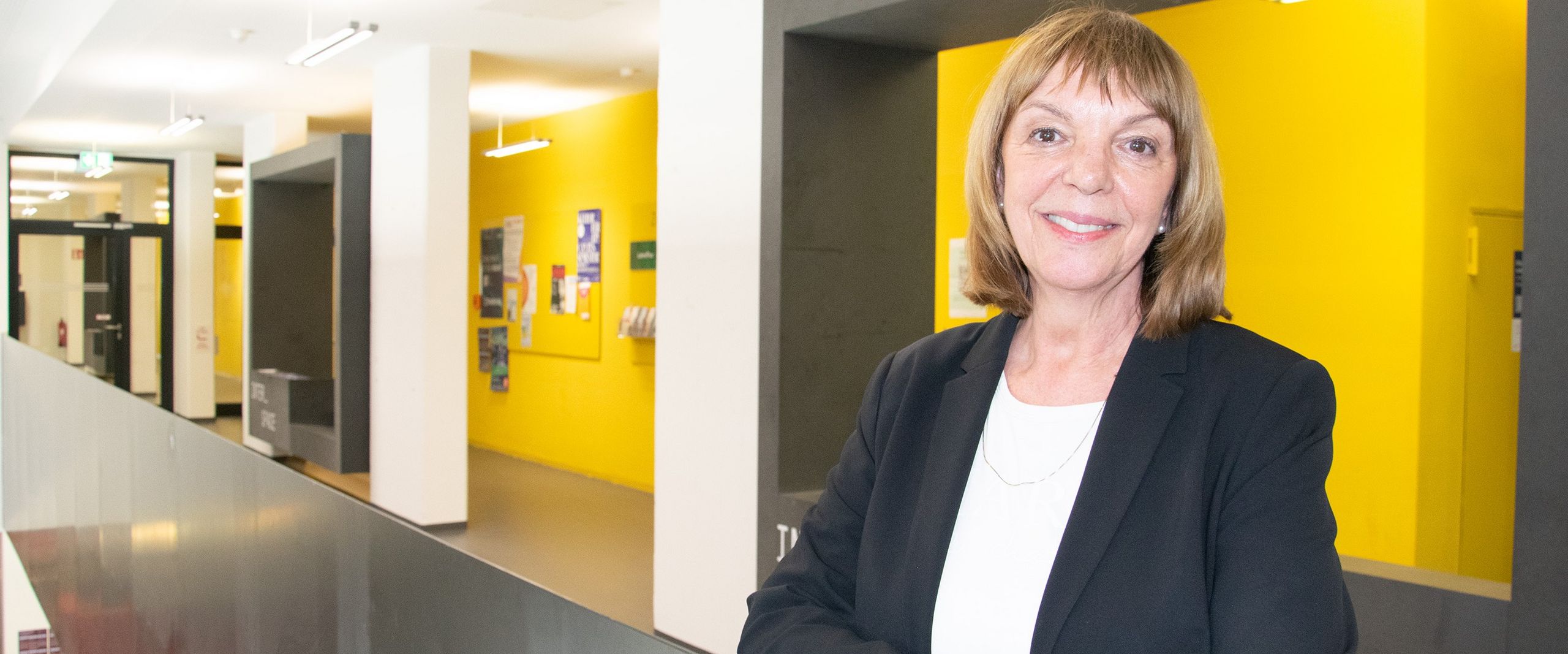
The Hochschule Bremen thrives on the people who study and work here, and who enrich it as guests. In our ‘Three Questions for…’ series, we introduce some of these people – sharing their perspectives, projects and visions. Here: Dr Sabina Schoefer. In June 2025, she will begin her second term as Vice-Rector for Change Management, Diversity and Digitalisation at the HSB. Prior to this, the Rector, Prof. Dr Konrad Wolf, appointed her for a further term. The Academic Senate unanimously approved his proposal at its meeting on Tuesday, 29 April 2025. In this interview, Dr Sabina Schoefer looks back on her first five years in the Vice-Rector’s Office and offers a glimpse of what lies ahead.
Ms Schoefer, you took up your post as Vice-Principal for Digitalisation in the midst of the coronavirus pandemic. How do you look back on that particular period?
Dr Sabina Schoefer: I remember it well – my start in the role was turbulent, which was down to the pandemic situation at the time. To remain operational during this unusual period, we had to establish reliable support structures across the university very quickly. Above all, the priority was to apply for and disburse BremenFonds funds for the HSB within extremely tight timeframes, in consultation with the universities and the relevant department in the State of Bremen. This was done in a manner appropriate to the funds’ purpose and was only successful through collaboration with the faculties, the IT centre, the administration and many dedicated colleagues working on digitalisation projects in teaching, research and administration. I am still grateful for this. It was particularly important at this time to initiate an information security management system that would protect the HSB against cyberattacks. We carried out security tests, known as penetration tests, to check our systems for vulnerabilities – with good results.
Just over a year ago, you also took on responsibility for change management and diversity. What are your priorities up to 2027?
Given the sheer volume of ongoing digitalisation projects and tasks, I can only give a few examples here – there is simply so much to do! Digitalisation, as a cross-cutting issue at a university, is by its very nature change management. This is also evident from discussions with colleagues at other universities. This will remain a key issue for those in charge. The assessments make this very clear. The approaches to dealing with it constructively and with the necessary patience are similar. The HSB is well positioned. Together with our ‘Scientific Management for Digitalisation and the computer Centre’, we have established a reliable steering board for digitalisation. This so-called ICT Steering Board oversees the entirety of the HSB’s digitalisation across hierarchies and centralised and decentralised structures. ICT stands for Information and Communication Technology. Keeping pace with the rapid and largely disruptive developments in the digital world of a university remains a challenge given the resources available for this purpose. For example, AI will be crucial for the HSB, as support processes in particular stand to benefit from it. It is also important to provide forward-looking support for the faculties’ IT service infrastructure. There is great potential here to position us as a university that is fit for the future and competitive.
It is particularly important to provide targeted support for our own staff’s digital skills through tailored programmes. This, incidentally, is the conclusion reached in collaboration with other universities. That is why a digital self-assessment has been developed as part of the HSB project ‘AddInno – Integrated Approach to Digital Innovation in Study and Teaching’. It is currently in the testing phase. If all goes well, we can begin using it in the autumn and, building on this, launch further training in digital skills. After all, the digital world of work has become more complex in recent years – we universities must respond to this.
Furthermore, cross-university collaboration within the state of Bremen and at the federal level is a key strategic priority. As in all other federal states, the HSB will need to consider shared IT services in view of the anticipated costs of digitalisation in order to keep pace with developments. A first step is the joint ‘State Initiative for the Digitalisation of Higher Education Institutions in the State of Bremen’ and the associated joint higher education project HIT. It is reviewing the licences of all higher education institutions in the State of Bremen in order to pool resources efficiently.
What’s next for diversity?
Since 1 April 2024, I have taken on the role of Diversity Officer for the Rector’s Office. Diversity is another cross-cutting issue that is currently of greater concern than ever to me, the HSB and universities worldwide. Our HSB sees itself as a cosmopolitan and tolerant institution that attaches great importance to respectful, non-discriminatory coexistence. There is no place here for any form of discrimination, intolerance or violence. This makes it clear: it affects all areas of our university and requires continuous cultural development.
Here too, given the wide range of issues involved, I would like to respond by providing some examples. It is important for HSB to bear in mind that the UN Convention on the Rights of Persons with Disabilities (UNCRPD) has been in force for almost 20 years. As a State Party, Germany is obliged under this Convention to promote the equal participation of people with disabilities and to take appropriate measures to this end. This, together with other federal and state legal provisions, gives rise to the obligation to design services in such a way that everyone can participate on an equal footing and free from discrimination. At Hochschule Bremen, the issue of accessibility is of great importance and a high priority. Like all higher education institutions in Bremen, we are doing everything within our means. However, resources in the state of Bremen are disproportionately scarce – particularly for this area. The Commission for the Implementation of the UN CRPD at Hochschule Bremen meets regularly, with me in attendance. It is currently focusing on the measures for 2025 and 2026, which are listed in the 2023–2027 Action Plan for the Implementation of the UN Convention on the Rights of Persons with Disabilities, developed through a university-wide process.
Another key priority for the HSB is the issue of anti-discrimination. A major focus of our work is the drafting of an anti-discrimination policy and guidance document. The ‘Procedures and Interventions’ working group has produced a draft for the HSB. This draft policy is currently under review: all departments, right down to the faculties, are involved. Your feedback is welcome in order to establish a broad consensus and legal certainty for everyone at our HSB. Alongside this, a practical guide on the subject is being produced so that students and staff have a clear framework and know where they can turn for reliable support. Closely linked to this is the planning and implementation of further training opportunities for staff and students on diversity issues and anti-discrimination.