
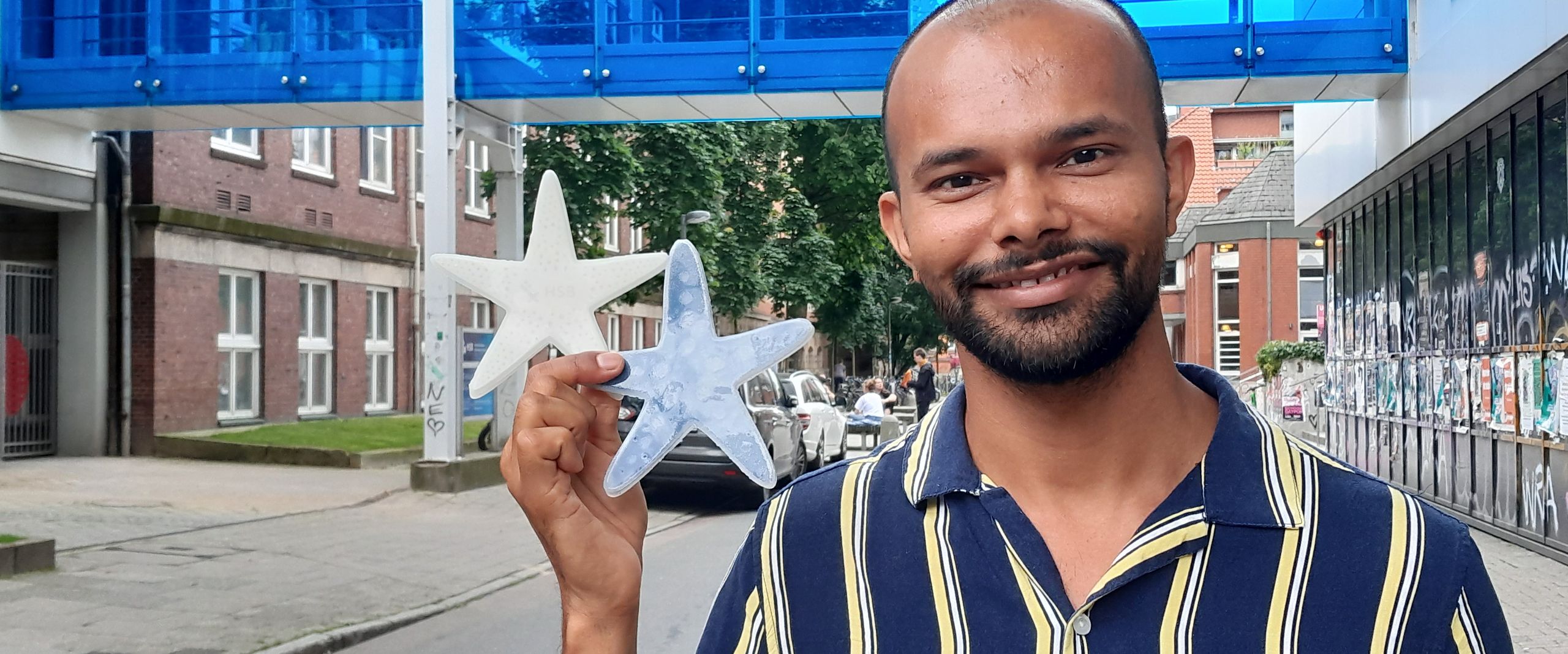
Here is international researcher Raman: The 32-year-old arrived at the HSB from India in 2020 to pursue a PhD in bionics. His first major milestone: he and his two PhD supervisors, Prof. Dr Susanna Labisch and Prof. Dr Jan-Henning Dirks, recently filed a patent for a new material that shows great potential. In doing so, they have put their knowledge of the capabilities of starfish to good use.
Mr Raman, as part of your PhD research, you have developed a new material made from 3D-printed plastic and silicone that can be easily bent and moulded to a perfect fit using heat. What does the starfish have to do with this?
Raman: Starfish have an astonishing ability: they can stiffen their normally soft and flexible arms in a fraction of a second, so that the new shape cannot be altered even with considerable force. We have utilised this ability in the development of our new material.
How does it work?
The structure consists of a special plastic forming the inner skeleton and a silicone coating. The material can be produced very cost-effectively. When heated, it bends very easily and can be customised to fit. To demonstrate this principle, known as ‘morphing’, in a playful way, we’ve made starfish out of it in our lab. If you place them in hot water, they become soft and can be bent very easily. When they cool down, they become hard and retain their shape. Just for fun, I’ve shaped some pen and mobile phone holders to demonstrate this. We’ve also incorporated heating cables into the material, so it can be heated electrically very easily and quickly.
How can business, industry and society benefit from your patent?
This new material has a wide range of potential applications. Take medicine, for example: it could be used to replace traditional plaster casts or splints in cases of broken bones. If you need to adjust the shape during treatment or remove it briefly – for example, to have a shower – you don’t have to destroy it and make a completely new one. You can adjust it again and again using heat. Ultimately, the splint does not end up in the bin, but can be recycled. It would therefore be sustainable.
Another example is aircraft construction: the material’s properties are needed, for instance, to adapt the shape of an aircraft’s wings to the different requirements during take-off, landing and cruising. The control systems previously required for this, such as the landing flap technology, are among the most complex components of an aircraft. If we succeed in technically replicating the starfish principle, this could simplify the design of aircraft wings many times over.
In the automotive industry, the material could, for example, be used to enhance seating comfort: if the seat surface of a car seat were made of this material and heated, it could adapt precisely to the ergonomics of the person sitting on it.
Do you also have ideas on how Raman’s new material could be used?
Feel free to message him on Instagram: Raman @team_morphiee